Project
Resist.
No justice without
resistance
Project Resist works with black, minority and marginalised women to realise their rights and freedoms.
We work through grassroots empowerment, building solidarity and fearless campaigning for systemic change.
We create change in three ways
Roots
We build women’s capacity at the grassroots to challenge violence and injustice and hold institutions to account.
Solidarity
We work in partnership with a range of front-line women’s organisations to build our shared power to challenge injustice.
Resistance
We campaign fearlessly for systemic change alongside women and organisations most affected by male violence and social injustice.
News
View All
Double Injustice: Public meeting on 12 July, 2.30pm to 4.30pm
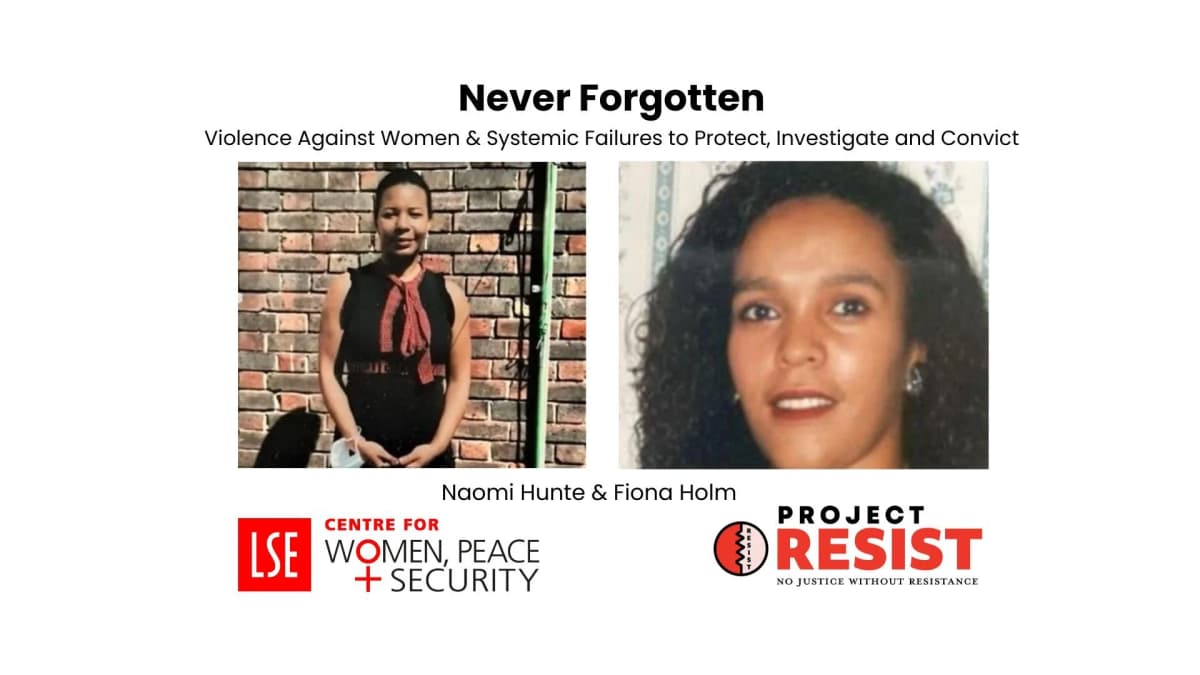
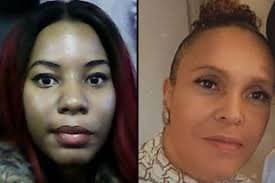
Fiona Holm and Naomi Hunte were killed by the same violent partner.
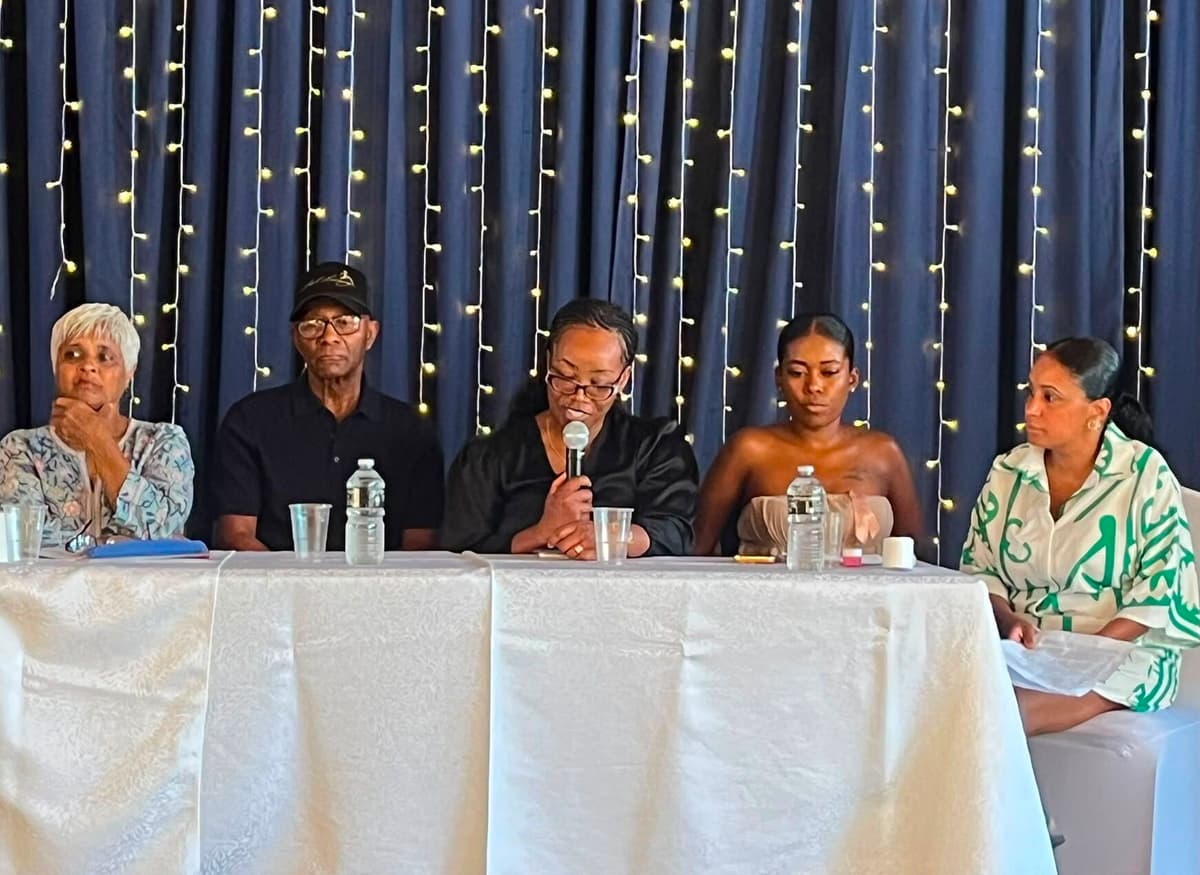
Fiona and Naomi's families are asking us all to come together to ensure that the police are held accountable for their failures and to ensure nothing like this ever happens again.
As friends, as neighbours, as concerned citizens, as campaigners for women's rights and against racism, we need to support their fight for justice.
Come to this public meeting on 12 July, 2.30pm to 4.30pm.
Register: https://www.eventbrite.com/e/double-injustice-the-cases-of-naomi-hunte-and-fiona-holm-tickets-1992070596780

New report into the criminalisation of black and minority women
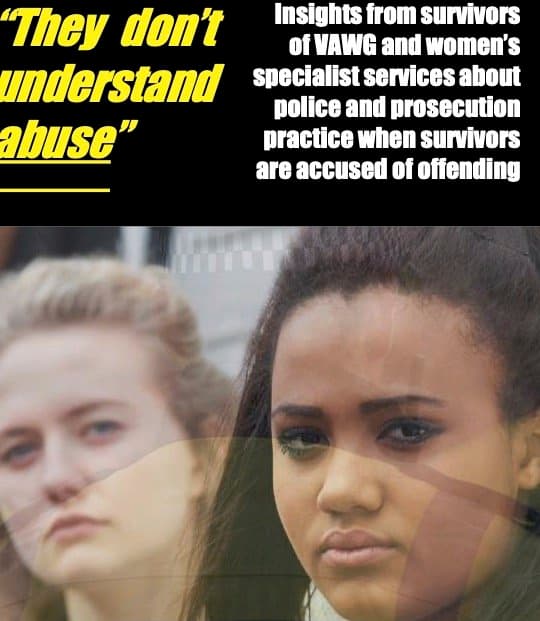
Pragna Patel, our co-director, conducted the research for the vital report published today by [Centre for Women's Justice](https://www.linkedin.com/company/centreforwomensjustice/) on the unjust criminalisation of women who are themselves victim-survivors of abuse. The report, 'They Don't Understand Abuse', presents insights from survivors of violence and women's specialist services about police and prosecution practice when survivors are accused of offending, and recommends urgent reforms. One case shared in the report involves a survivor who was accused by her abusive partner of child abuse, and was separated from her children, including her breastfeeding baby, as a result. Pragna Patel said: “The case examples and reflections in this study suggest the privileging of the male voice and downgrading of the voices of women, particularly those who are marginalised, including Black, Asian, minoritised and migrant women. Vulnerability itself appears in some cases to be a driver of criminalisation and detention, which is directly contrary to the public interest.” Harriet Wistrich, Solicitor and Chief Executive Officer of CWJ, said: “For many years now, CWJ and others have called for legislation to provide effective defences for victims of domestic abuse who are accused of offending, and for improved leadership, training, guidance and accountability mechanisms to improve practice by police and prosecutors so that victims’ experience of abuse is properly taken into account in any proceedings against them. These calls have recently been echoed by the government-appointed independent Women’s Justice Board and we await the government’s response.'' For the full report, please go to this link: [https://lnkd.in/esSMBABg](https://www.linkedin.com/safety/go/?url=https%3A%2F%2Flnkd%2Ein%2FesSMBABg&urlhash=b6bS&mt=lvcczecoDx7DnEqm8fICVwHyQEUoefVQxZi9g1c3M7TjgrrgmtoJCSrCSd8lS7lh5L9YzfIPDL-vPZHRT2juJEWspneL13N5pA0vrAm_vYJ_RzAHLfCah581JW8&isSdui=true) For the briefing, please go to this link: [https://lnkd.in/e7ZwG6zx](https://www.linkedin.com/safety/go/?url=https%3A%2F%2Flnkd%2Ein%2Fe7ZwG6zx&urlhash=pDf7&mt=asYgOskbuKUu1nBYJcjc-kSNoEMBEue5Vk6ILreJKWpawlz-j6x-ObFwz9guef8xs19_9VO5wmzdCG_RV5iy_OMY0QqxwwYlO8lG9gMVyPBd4gDJsEX5nbAT1w0&isSdui=true) For the press release, please go to this link: [https://lnkd.in/e_sCiHtm](https://www.linkedin.com/safety/go/?url=https%3A%2F%2Flnkd%2Ein%2Fe_sCiHtm&urlhash=f1RZ&mt=nWxxhg-awzAjHaKlyFWIB4ii669-lbMGhkaWvSmJqoa32_NXVFy2wHNl_uOycBZRyfQFQddh4E9E0ZdnNCYVQGknvSJyxtlI9GexLlRvNv8C53dUCaVBjp6LHFo&isSdui=true)

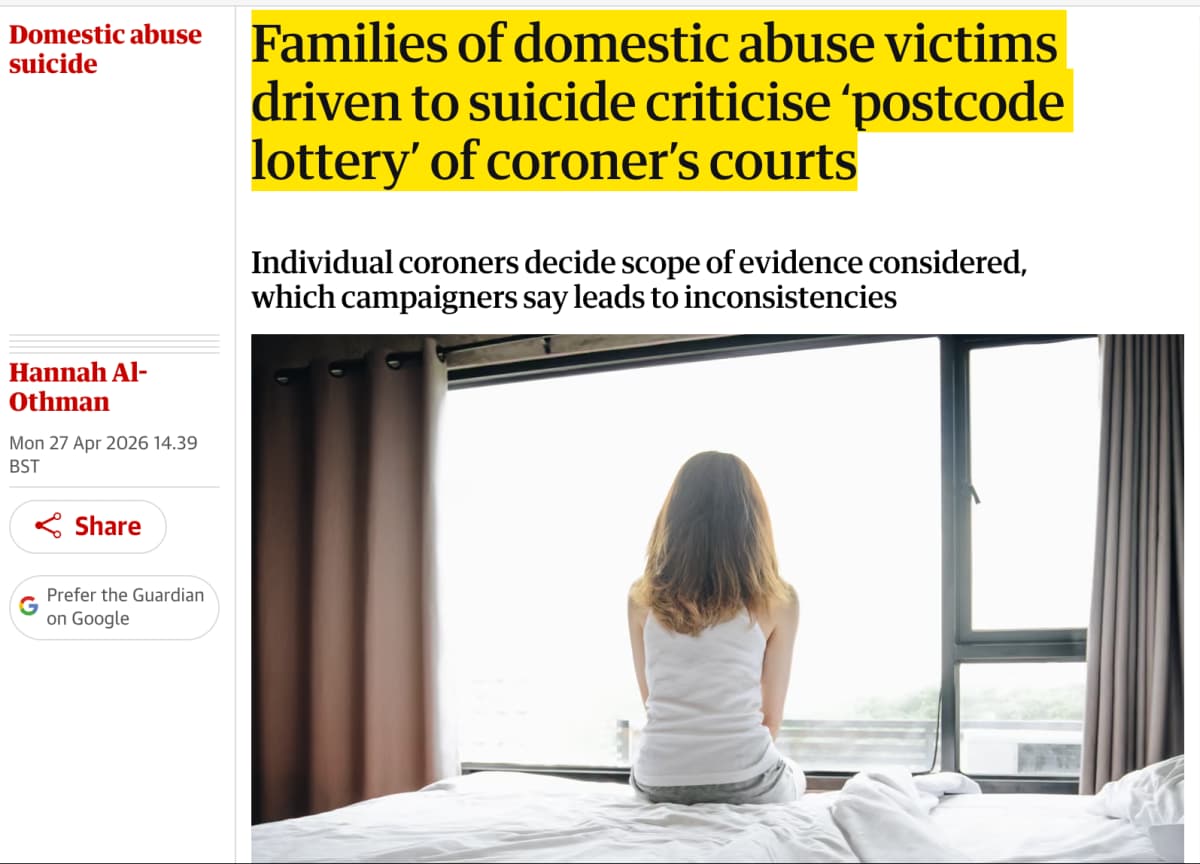
Families of domestic abuse victims driven to suicide criticise 'postcode lottery' of coroner's courts
Pragna Patel of Project Resist spoke to The Guardian for an investigation into the 'postcode lottery' faced by families of domestic abuse victims driven to suicide. The piece exposed how individual coroners decide what evidence to consider, leading to wildly inconsistent rulings on whether a suicide following abuse should be treated as a potential homicide.
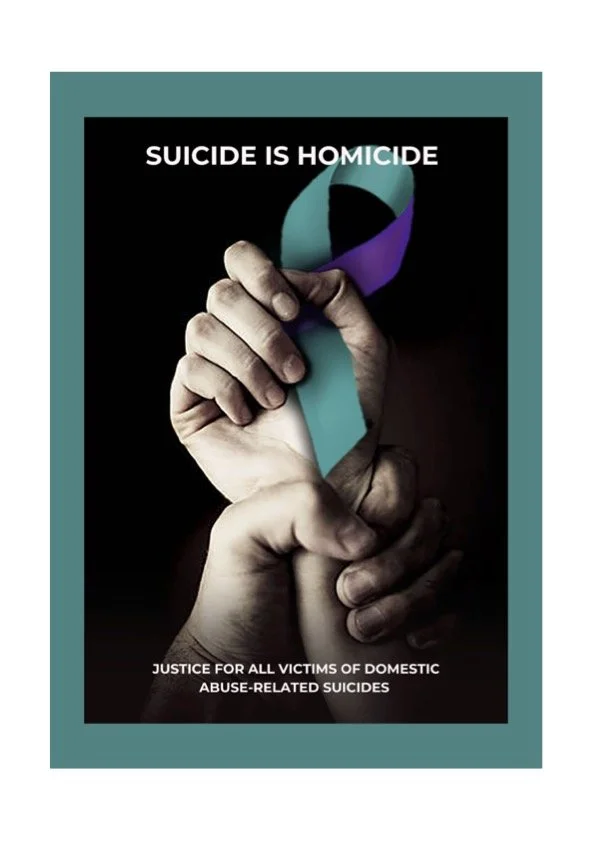
The article amplifies the Suicide is Homicide campaign and the experience of bereaved families calling for systemic reform. Project Resist continues to push for clear national guidance so that domestic-abuse-related suicides are investigated with the same rigour as other suspicious deaths.

Response to the Taryn Baird Outcome
Project Resist issued a statement on behalf of the Suicide is Homicide campaign in response to the Taryn Baird court outcome. The verdict does not diminish the significance of our campaign and the wider struggle waged by families seeking justice in contexts of domestic abuse and coercive control.
We stand with Taryn's family and all the families who have lost loved ones to abuse-driven suicide. This case underscores why the legal system must take seriously the evidence of coercive control as a driver of preventable death, and why systemic reform of coronial and prosecutorial practice is urgent.

The Conspiracists Screening
Project Resist hosted a screening of 'The Conspiracists' — a Liz Smith film documenting women in the MAGA movement and the rise of far-right thinking. The screening was followed by a panel discussion chaired by Project Resist's Pragna Patel with the Director.
The event drew connections between the rise of far-right conspiracy networks and the patriarchal politics that target women, minorities and migrants. It forms part of Project Resist's ongoing work on the gendered dimensions of the far right and the strategies needed to resist it.

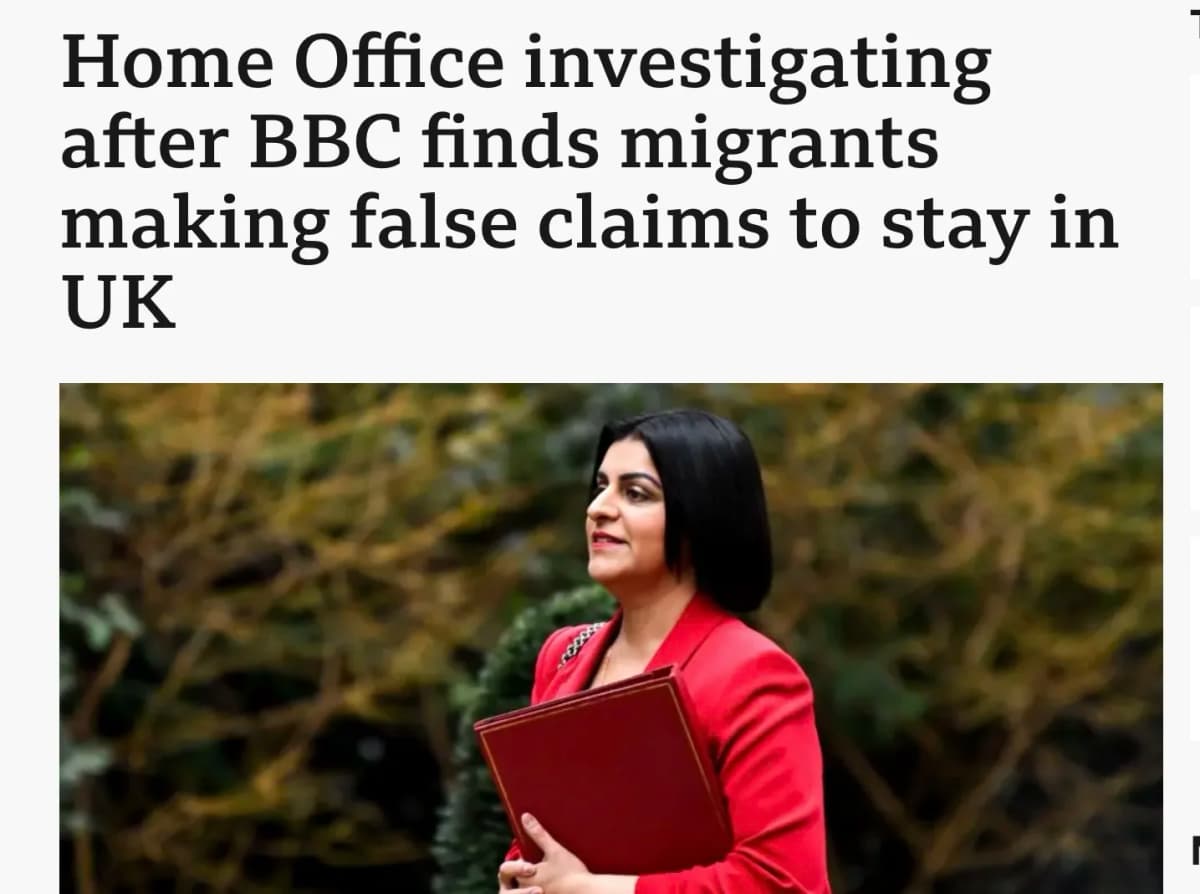
Project Resist responds to BBC investigation into false domestic abuse allegations
by Pragna Patel
Project Resist deplores any exploitation of the Domestic Violence Rule route to settlement in the UK by unscrupulous so-called immigration advisers and organised criminal gangs.
False claims of domestic abuse harm the very people that organisations like ours support: the most vulnerable victims of abuse.
However, in its recent investigation report, the BBC has not attempted to ascertain the scale of this issue: neither how many such false claims are made nor how many are ultimately successful. Instead, the small number of cases they have identified are presented as a broader problem.
We know from our work and that of other women’s organisations that the vast majority of claims under the Domestic Abuse Rule are genuine, providing a vital lifeline for women with insecure status who are trapped in escalating and life-threatening forms of gender-based harm.
The Domestic Abuse Rule came about as a result of decades of campaigning to protect victims (mainly women) and their children from domestic abuse – including physical and sexual violence, imprisonment in the home, domestic servitude, restrictions on movement, deprivation of food and access to medical and financial support and threats of serious harm.
The route saves the lives of thousands of women and children and enables them to protect themselves and regain their dignity and autonomy.
We are fully behind the government’s efforts to clamp down on those who profit from manipulating the immigration system. Indeed, for many years, those of us working on the front-line have been complaining about the financial exploitation of vulnerable and desperate victims and have called for them to face the full force of criminal and immigration regulatory laws that are meant to root out fraudulent practitioners.
The BBC has also failed to mention that organisations like ours and others have also worked with the Home Office to develop tighter guidance for Home Office caseworkers (Appendix VDA) in order to ensure that the assessment of applications under the Domestic Violence Rule is as rigorous as possible. This new guidance sets out the range and types of evidence needed to prove domestic abuse. As a result, organisations working with domestic abuse victims will now have to provide information about their track record, qualification and experience in supporting such victims alongside evidence of risk assessments and the support provided. This should help to make it more difficult for fake claims to succeed.
We welcome Jess Phillips’ recognition of the need to protect genuine victims of domestic abuse and call on her to ensure that the abhorrent misuse of the immigration system will not result in yet another cynical attempt by the state to remove a flagship measure of protection for which we should rightly be proud.
We also call on her to work with us to discuss our concerns about the Earned Settlement Scheme which will deny many vulnerable migrant women the protection they so desperately need to survive domestic abuse. Restoring the integrity of the immigration system and maintaining public trust is not about demonstrating cruelty and indifference to migrants: it should be about ensuring that nothing is done to violate our legal and moral obligation to provide humanitarian care and human rights protection to the most vulnerable in our society.
For more information, email comms@projectresist.org.uk

Never Forgotten: Violence Against Women and Systemic Failures
Project Resist hosted 'Never Forgotten: Violence Against Women and Systemic Failures' — a public event marking the names of women killed by male violence in the past year and the systemic failures that contributed to their deaths.
The event brought together families, lawyers, parliamentarians and campaigners to read names, share testimony, and commit to a more honest national reckoning with the structures that fail women — particularly black and minoritised women — at every stage of the justice system.

IWD Speaking Events: Religion, Nationalism and the Mainstreaming of the Far Right
To mark International Women's Day 2026, Project Resist took part in a series of speaking events on the theme 'Religion, Nationalism and the Mainstreaming of the Far Right'. Speakers included Project Resist's Pragna Patel alongside partners from across the women's sector.
The events examined how religious fundamentalism, nationalist politics and far-right movements converge to undermine women's rights — and the strategies feminist organisations are using to defend hard-won gains and build solidarity across communities.

Claudia Jones Commemoration Event
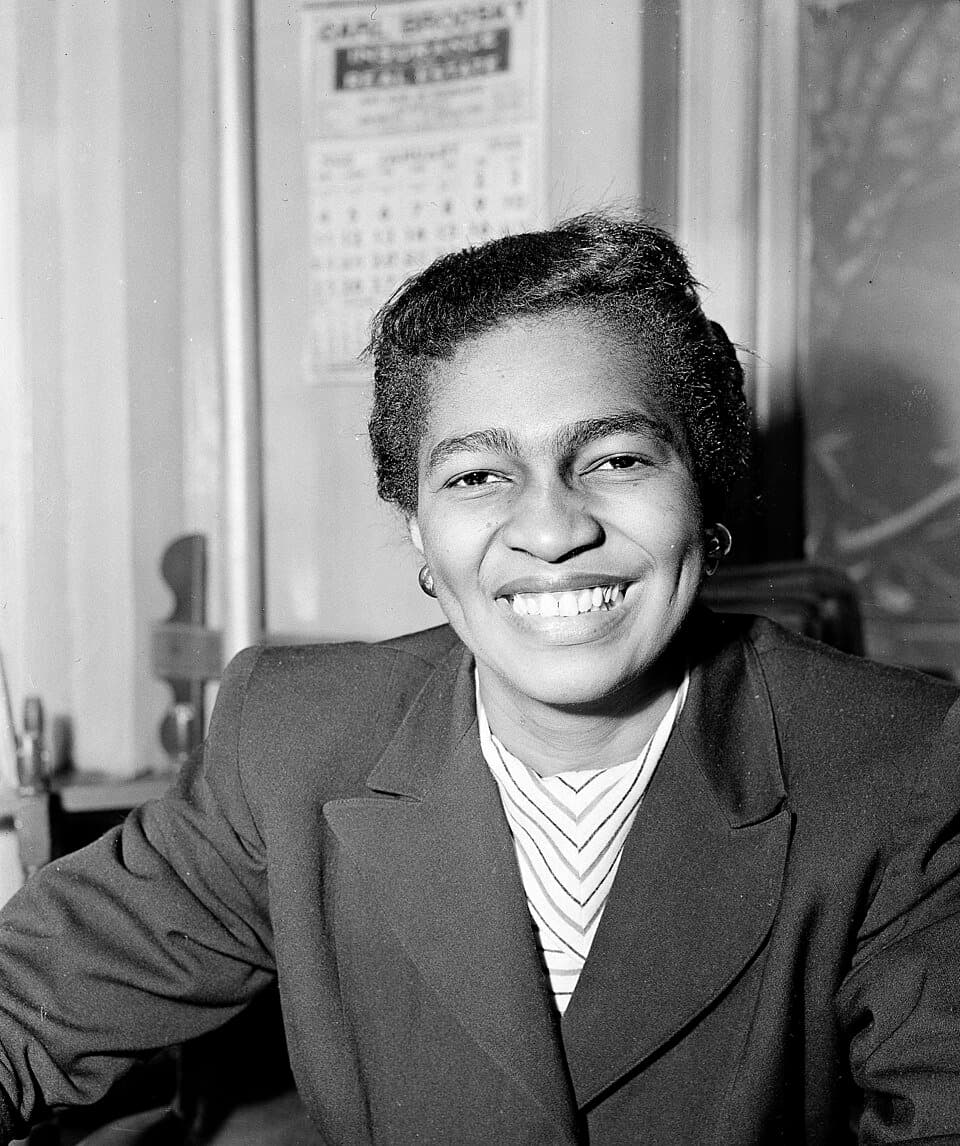
Project Resist took part in the annual commemoration of Claudia Jones at Highgate Cemetery, marking the legacy of the Trinidadian-British communist, feminist and journalist who founded Britain's first major Black newspaper and was central to the founding of the Notting Hill Carnival.
The event drew speakers and supporters from across the black feminist and anti-racist movement. It is a moment of reflection and recommitment to the work of building intersectional solidarity in the tradition Claudia Jones helped to establish.

Project Resist & FiLiA Statement on "Earned Settlement"
## JOINT STATEMENT ON "EARNED SETTLEMENT"
The Government is currently proposing to bring in a new immigration model for settlement – the 'earned settlement' scheme – which will make the granting of permanent residence dependent on financial contributions and high levels of integration and compliance rather than length of residence. If enacted, it will have a terrifying impact on the poorest and most vulnerable migrants, particularly women. It will create a hierarchical, two-tiered society made up of British citizens and non-citizens, with far-reaching consequences not just for migrants but for British society as a whole.
We need to resist this proposal before it is too late. As organisations working for women's rights and migrant justice, we have been shocked by the brutality of ICE, the US immigration and border patrol force, and its use of violence to terrorise migrants and the US citizens who support them. We should not think the UK is immune from such state-orchestrated cruelty. The enactment of 'hostile environment' immigration policies by successive governments has, over the years, created fear and uncertainty for many migrants. It has led to unprecedented levels of immigration raids and enabled widespread public displays of anti-immigration racism and violence. The political direction of travel could not be clearer. This is the time to join together in resistance.
'Earned settlement'
The proposed model is widely acknowledged to represent the most significant shake-up of the immigration system since the Immigration Act 1971. It will put settlement out of reach for most new migrants and also most of those who have built their lives here. Only high earners or those on priority routes will have access to an accelerated (three- to five-year) route to settlement. The majority will have to wait for up to ten or 15 years, or even more, before gaining residence rights, which is up from the current five years. This includes children and those who work in transport, the care sector and other frontline public services. Small discounts to the residence timeline may be applied if migrants can show higher levels of 'integration', A-level fluency in English and 'good character and conduct'. Those who are ill or disabled or have dependent partners or children or who have relied on public funds, or those who have arrived in the UK illegally, entered on a visitor visa or overstayed their visas, may have to wait for up to 20 years. Even those who are fleeing persecution are likely to have to wait 20 years or more for settlement rights. This will make the UK's asylum laws some of the toughest in Europe.
The rationale used to justify the settlement proposals is ostensibly to facilitate 'integration'. But there is growing consensus that they will cause immense poverty, hardship and division, and make integration even more difficult to achieve for many migrants.
Impact on women
The proposals are not only profoundly racist and classist, but also sexist. We are deeply concerned about the impact of the proposals on vulnerable migrants, including women, and we urge the Government to share the Equality Impact Assessment they say they have carried out in relation to this proposal. Women will be disproportionately affected. They are more likely to be dependants of male earners, to work part-time or in informal or low-paid sectors, to have childcare and other domestic responsibilities and to rely on welfare benefits. The disadvantages and barriers to integration they already face will be exacerbated by their effective exclusion from early routes to settlement.
Women who have experienced domestic abuse, coercive control, trafficking and exploitation have often overstayed their visas or entered the UK illegally – through no fault of their own. Most depend on the welfare safety net to exit abuse and overcome trauma, but under the proposals they will be penalised and made to face long qualifying periods. In addition, those who try to defend themselves against violence or have been criminalised as a result of counter-allegations made by abusers – who increasingly use such tactics as part of their coercive control – will also be denied early settlement. Immigration rules such as the 'no recourse to public funds' (NRPF) condition already force many women into economic dependency, placing them at serious risk of abuse and harm for long periods. Under the new proposals, their economic dependency on abusive and exploitative men will be further heightened and they will remain trapped in destitution and precarious situations for even longer.
Settlement is a right, not a privilege
Far from encouraging integration, the proposals are likely to add to a growing migrant underclass subject to punitive state responses, anti-immigration racism, sexism, exploitation and degradation. If enacted, they will contravene the Government's legal and moral obligations to provide humanitarian care and human rights protection. Our concern is that the Government knows this but is deliberately choosing to be driven by anti-immigration politics.
We deplore this latest unconscionable move to placate the far right. We call on the Government to reconsider the earned settlement model in its entirety. It will cause untold distress and hardship within migrant families as members, including children, are forced along different and arbitrary paths to settlement and citizenship. It will also create divisions between British citizens and migrants and further institutionalise hatred, intolerance and exclusion. The Government contends that settlement is a privilege, not a right, however we assert that settlement and citizenship rights should no longer be rooted in the country's colonial legacy, but must be forged in the values of democracy and our shared humanity.
Our voices are more powerful together. If you would like to sign this statement in solidarity, please email: comms@projectresist.org.uk
This statement is signed and endorsed by Organisations & Individuals:
For more information also see FiLiA's website (https://www.filia.org.uk/latest-news/2026/2/25/joint-statement-from-project-resist-and-filia-on-earned-settlement)
Anita Gera, Co-founder, Hague Explained CIC
Brighton Women's Liberation Collective, Organisers of Sisters' Salon
Centre for Women's Justice
Cristina Odone, Chief Executive Officer, Fair Hearing
Cris McCurley, Legal Consultant, Head of international Family Law, Ben Hoare Bell Solicitors
Dania Thomas, Director of Ubuntu Women Shelter
Dr Sara Reis, Deputy Director and Head of Research and Policy, Women's Budget Group
Erin Leonard Parker, Director of Policy and Advocacy, Represent Women
Faty Kane, Executive Director, The Angelou Centre
Feminist Dissent
Firoza Mohmed, Chief Executive Officer, Humraaz
Halaleh Taheri, Executive Director & Founder of MEWSo
Jasmine Mohammed, Director of Safety4Sisters
Jennifer Nadel, CEO Compassion in Politics
Jo Gough, Rise CEO
Hari Reed, Joint CEO, Asylum Welcome
Kate Agha, Sundial Centre for Education on Harmful Practices (previously Oxford Against Cutting, OAC)
Karma Nirvana
Labour Women's Declaration Working Group
Laura Seebohm, Feminist Leader in the Women's Sector
Lesbian Immigration Support Group (LISG)
Dr Manal Ahmed, Managing Director, We Are the Tree CIC
Maryam Namazie, Spokesperson of One Law for All
Mollin Delve, Chief Executive Officer, Phoebe Centre
NaariSamatã
One Million Women and Girls (1MW&G)
Onjali Rauf, Founder and CEO of Making Herstory (MH) & O's Refugee Aid Team (ORAT)
Rights of Women
Sarbit Ganger, Director AWRC
Social Scientists Against the Hostile Environment
Sonia Jalal, CEO, Hull Sisters
Surwat Sohail, Chief Executive Officer, Roshni Birmingham
The Halo Project
Vicky Marsh, Assistant Director of Safety4Sisters
WWIN: Specialist Domestic Abuse Service
Amrita Shodhan, SOAS, University of London
Alice Bondi
Cathy Devine, Freelance Academic
Charlie Weinberg, Feminist Activist and Co-Founder of Women's Liberation Alliance
Debbie Waldon
Professor Eleonore Kofman, Middlesex University London
Esua Goldsmith, Feminist Writer, Facilitator, Strategist
Fiona Sheil, Researcher
Francesca Platt - Community Worker/Filmmaker
Georgie Wemyss, University of East London
Gita Sahgal, Feminist, Writer and Human Rights Campaigner
Jane Ayres
Jane Clare Jones, Feminist Philosopher, Writer and Activist
Judith Green, women's rights activist
Karen Smith
Kiri Tunks, Trade Union and Women's Rights Activist
Laura Seebohm, Feminist Leader in the Women's Sector
Liane Timmermann, lesbian feminist activist
Professor Liz Kelly, London Metropolitan University
Professor Mary Davis, Visiting Professor Royal Holloway University London & Co-Founder of Women's Liberation Alliance
Monika Neall
Natasha Walter, Author and Campaigner
Nira Yuval-Davies Emeritus Professor and Honorary Director of the Centre of Migration, Refugees and Belonging
Dr Rachel Hewitt, author
Professor Rashmi Varma, Warwick University
Rebecca Durand, ESOL Teacher
Roseanne Rabinowitz, Author and Activist
Sarah Johnson, Trade Union Activist
Sally Young, Feminist Activist
Stephanie Cole, feminist
Stephen Cowden Senior Lecturer in Social Work, University of Gloucester
Suzette Cullen
Yasmin Rehman, Feminist and Human Rights Activist

Accountability & Justice for Naomi & Fiona: New Petition Launched
Project Resist supported the launch of a Change.org petition demanding accountability and justice for Naomi Hunte and Fiona Holm — two women killed by the same abuser despite prior police knowledge of the risk he posed.
The petition calls for a public inquiry into the systemic failures that allowed a known perpetrator to continue offending. It is the foundation of the Double Injustice campaign, which centres the families of Naomi and Fiona and their fight for the truth.

Launch of the Double Injustice Campaign
## The Double Injustice Campaign
### Seeking Justice for the families of Naomi Hunte and Fiona Holm
### Double Injustice: Naomi Hunte and Fiona Holm
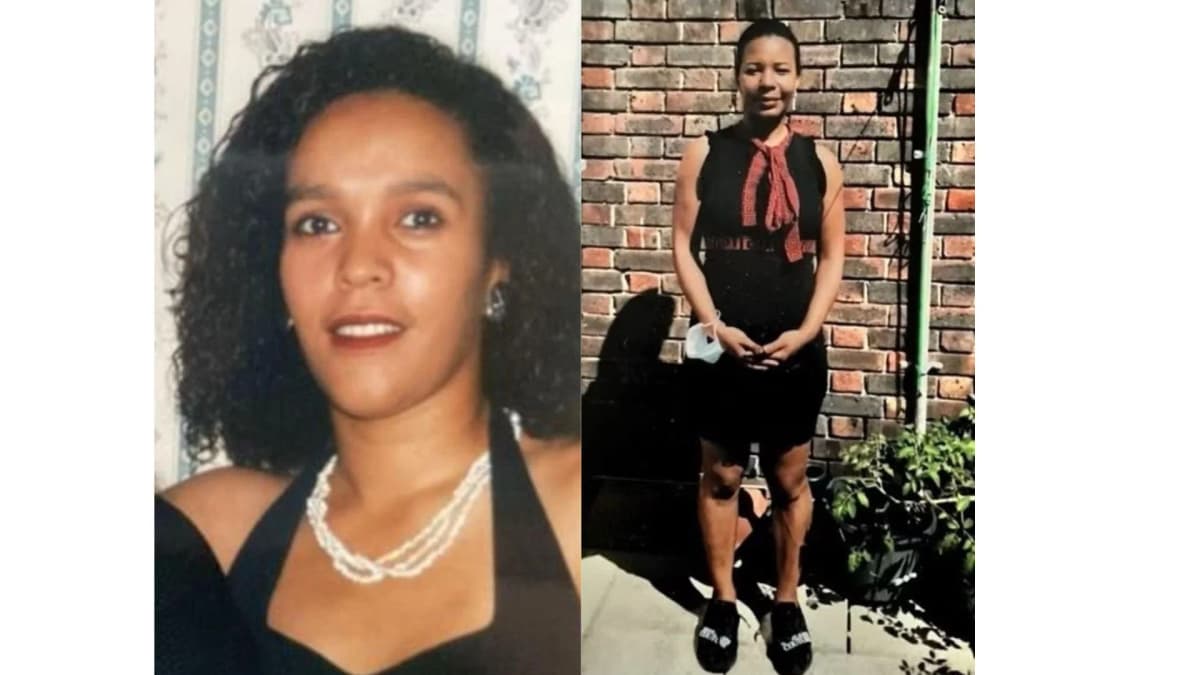
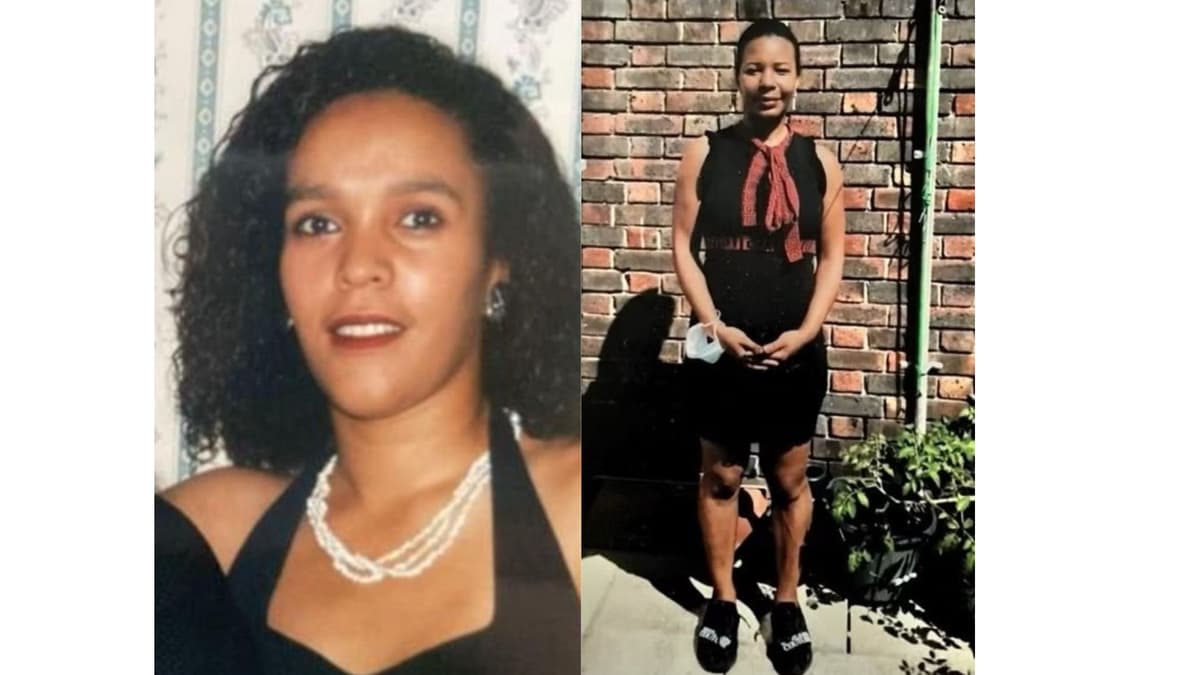
Naomi Hunte and Fiona Holm were killed by the same violent partner, Carl Cooper, within 16 months of each other. Both were from African Caribbean backgrounds, and both had mental health conditions which made them very vulnerable. On both occasions, the police knew of the risks to their lives but did not take any effective action, and both times the result was the woman's death. Both deaths were preventable.
[Sign the families' petition for justice here](https://www.change.org/p/justice-and-accountability-for-fiona-holm-and-naomi-hunte?source_location=search)
### NEWS Public Meeting in Lewisham London
### Sunday 12th July 2.30-4.30pm
Fiona and Naomi's families are asking us all to come together to ensure that the police are held accountable for their failures and to ensure nothing like this ever happens again.
As friends, as neighbours, as concerned citizens, as campaigners for women's rights and against racism, we need to support their fight for justice.
Come to this public meeting to learn more about the campaign and what you can do. This struggle is not only for Naomi and Fiona, it is for all women harmed by police failures.
SPEAKERS
- Savannah Holm-Aderemi, Fiona's daughter
- Basil Hunte, Naomi's father
- Ellis Skillen, Fiona's sister
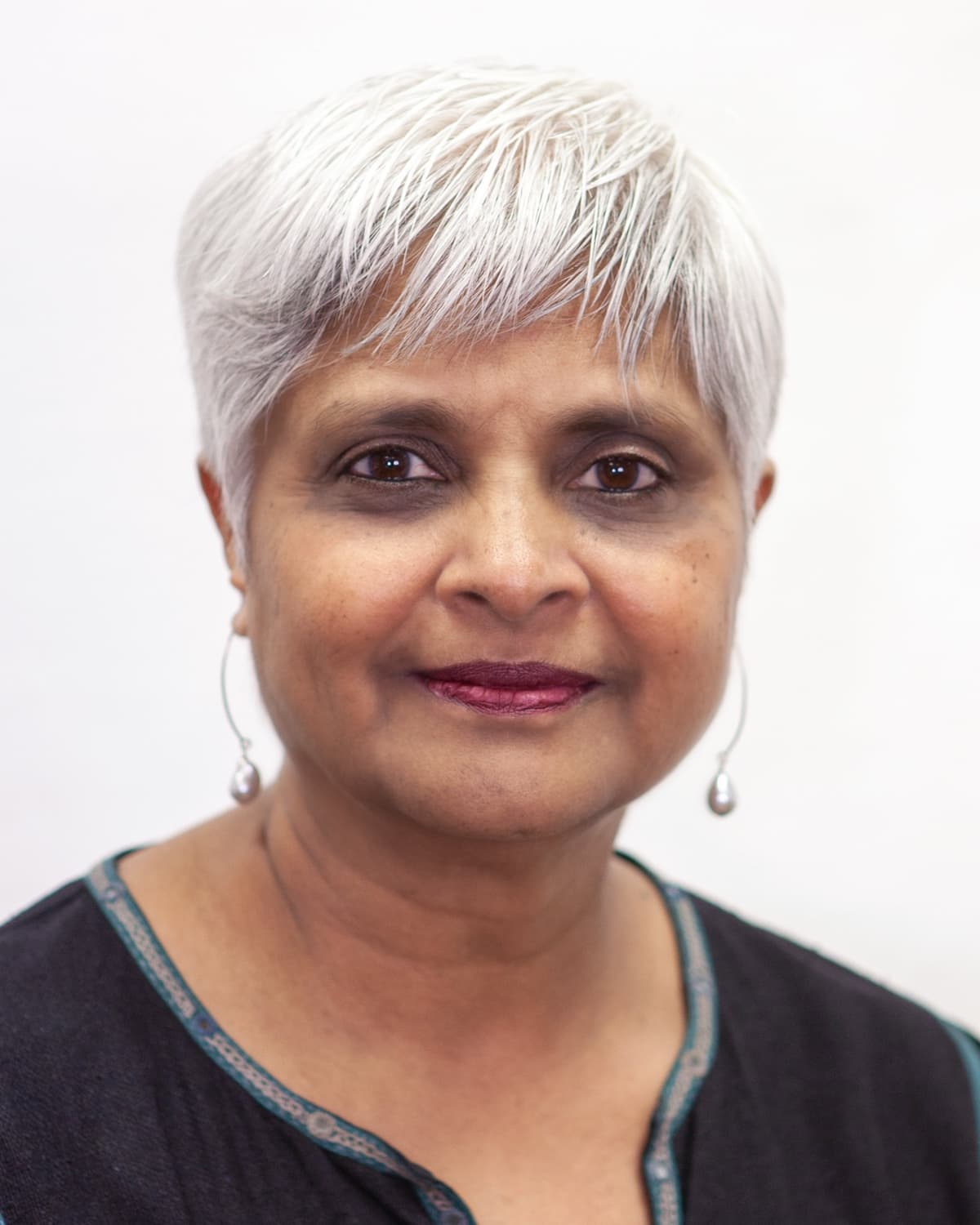
- Pragna Patel, co-director, Project Resist
- Suresh Grover, founder, The Monitoring Group
- Simon Israel, Channel 4 News correspondent
- Natasha Walter, author and campaigner
[Book your free place here](https://www.eventbrite.com/e/double-injustice-the-cases-of-naomi-hunte-and-fiona-holm-tickets-1992070596780)
Naomi's story
Naomi Hunte was aged 41 years when she was found dead in her flat on 14 February 2022. Between November 2020 and October 2021, Naomi had reported Cooper to the police at least seven times for his actions including sustained harassment and stalking, assault, threatening behaviour and for "forc[ing] himself on her". Despite the repeated police callouts and Cooper's sustained and escalating violence, crime records were not opened and risk assessments were not undertaken on each occasion. Cooper was arrested once but then released without charge. In effect, Naomi was never protected. Finally, Cooper killed her by repeatedly stabbing her.
When Cooper was ultimately sentenced, the trial judge commented that "The murder probably involved a motivation related to sexual conduct, possibly due to Ms. Hunte refusing to have sex with you.' Carl Cooper was arrested by the police for her murder the same day but he was released on bail. In February 2023, Cooper was re-interviewed but instead of being charged he was "released under investigation" with no bail conditions. By this time Carl Cooper was already seeing Fiona Holm.
Cooper's trial started on 4 June 2024 at Woolwich Crown Court. He was convicted of both Noami and Fiona's murders. On 2 July 2024, Cooper was sentenced to life imprisonment with a minimum term of 35 years. Although Carl Cooper was eventually apprehended, prosecuted, convicted and sentenced for both murders, no one in the police is yet to be held accountable for these failings.
Fiona's Story
Fiona Holm was aged 48 years – but had the mental age of a teenager – when she entered into a relationship with Carl Cooper in late 2022 while he was still on bail for Naomi's murder. She suffered from autism and alcohol dependency issues.
On 8 April 2023, Fiona called the police alleging that Carl Cooper had hit her with a crow bar. When she spoke to the police, she alleged that he had previously stabbed her with a screwdriver. However, after Cooper was interviewed, and despite the police knowing Cooper's background and that he was under investigation at the time for Naomi's murder, the police closed the case without further investigation.
Fiona Holm was last seen on 20 June 2023. A third party call the police to report that Carl Cooper had murdered someone but this was treated as a hoax and not actioned. Fiona's family and social worker repeatedly called the police from the end of June, but police did not arrest Cooper until 11 July 2023 giving him the opportunity to dispose of Fiona's body. Fiona's family were forced to try and investigate her disappearance themselves. By the time Cooper's home was searched he had stripped his home and burnt key evidence. Fiona's body has yet to be found despite her family's efforts to find her, so they cannot even begin the process of grieving for her loss.
Why this campaign?
Project Resist is supporting the families of Naomi and Fiona who have come together to make sense of why the police failed so abysmally in their duty of care to both women. In the absence of any other explanation for these failures, the families believe that the police were able to ignore both women simply because they were black, female and disabled. They are seeking urgent answers from the police in their struggle for justice.
"The campaign is important to me because, if the police had listened to my sister Fiona and Naomi, would both still be here. I've lost an important person in Fiona. The police should have done more when she went missing. They did nothing. We had to physically go and look for her ourselves, which we shouldn't have had to do. I feel angry, really angry and hurt. How can they expect us to trust them at all? " (Elise - Sister of Fiona)
"We want to find mum's body and lay her to rest. We need the future to be better than it has been for our girls and boys. I feel angry and hurt. You see on the video - the police didn't care when they talked to us. Vulnerable people like mum and Naomi should be entitled to more support. " (Savannah – daughter of Fiona)
"The police cannot be trusted to do what they are supposed to do. It's a big let-down. It took a year for him to go and kill another lady. If they had done their job, he would not have been in a position to kill for a second time. It's hard to understand why." (Basil, father of Naomi)
Tragically, the deaths of Naomi and Fiona are only the latest, albeit particularly egregious examples, in a long line of cases where reports from women of abuse at the hands of violent partners have been dismissed and investigations into their subsequent murders have been botched.
The Issues
These cases raise serious questions about continuing police failures in responding to domestic abuse cases. Cooper was a serial perpetrator of high-risk domestic abuse against multiple women and had been convicted in Jamaica in 1989 for four offences of violence against women. Cooper had also been previously prosecuted in the UK in 1999 for the attempted murder of his ex-partner and it is understood that he had also been a suspect in multiple other violent offences against women.
In Cooper's sentencing remarks, the trial judge stated the following:
"You have a history of acting in a controlling and coercive manner to your sexual partners. In 1989 you were convicted in Jamaica for four offences of violence. Ms Hunte had made previous complaints to police about your controlling and coercive behaviour. Ms Holm had also made a previous complaint to police about your behaviour. She had also complained to friends that you had stabbed her with a screwdriver. Other women have also made similar complaints about your conduct. I am sure that you have, over many years, been a great danger to women."
We hear about government claims of 'clamping down on police failings', and the police speak about treating domestic abuse as a 'top priority', 'on par with terrorism'.
In practice, what we see is an endless repetition of the same failures year after year. There is a clear lack of political will needed to hold individual police officers and the wider criminal justice system to account.
Trust in the police and criminal justice institutions has continued to erode while the state fails to grapple with the institutional perpetuation of racism, misogyny, ableism, and abuse of power that dominates the policing of violence against women.
The Campaign's Demands
This campaign has been launched to:
1. Call on the police to renew their search for Fiona's body with regular updates to the family, and call for witnesses to come forward with any information that can help to locate her body.
2. Build support for the families in their struggle to ensure effective investigations into the police misconduct and discrimination they have had to endure in both cases.
3. Call on the government to work with us to introduce effective measures to fulfil the state's obligations to protect, prevent and prosecute domestic abuse cases and deliver real police accountability. We seek:
a) a radical overhaul of the current system of policing domestic abuse and domestic abuse-related homicides;
b) a recognition of the obstacles faced by disabled and minoritised women in engaging with the criminal justice system and accountability when the police fail to take reasonable steps to support women in accordance with their own guidance;
c) the implementation of robust disciplinary measures where there are clear failures in the investigation of domestic abuse/homicides, including in relation to the effective supervision of those investigations.
### " We want to find mum's body and lay her to rest. We need the future to be better than it has been for our girls and boys. I feel angry and hurt. You see on the video - the police didn't care when they talked to us. Vulnerable people like mum and Naomi should be entitled to more support. "
### (Savannah – daughter of Fiona)
Double Murders or Double Injustice?
In the aftermath of Carl Cooper's murder trial, the police patted themselves on the back for having secured a conviction for the double murder. What they failed to acknowledge is that this was not just a case of double murder but of double injustice generated in a large part by their own mistakes, negligence and inaction. Had they taken effective action in accordance with the law and guidelines on domestic abuse and coercive control, both women might still be alive today.
At the heart of these deaths lies a continuum of abject police failure: their failure to investigate the reports from Naomi and Fiona of serious and life-threatening violence; their failure to take steps within their powers to protect Naomi, their failure to adequately investigate Fiona's allegations of serious violence, their failure to warn Fiona about Carl Cooper's previous history of violence against Naomi and multiple other women; their failure to connect both cases; and their failure to conduct a timely and proper investigation into both of their deaths.
To add insult to injury, after Naomi's murder the Metropolitan Police did not record the case as one requiring an investigation or refer the case to the Independent Office for Police Misconduct, despite the fact that Naomi had repeatedly reported Cooper before she was killed and that her family had expressed concern that she had been the victim of overwhelming police failure to protect her. Whilst Fiona's case was referred to the IOPC after her murder, the IOPC declined to investigate. Following legal submissions, the IOPC finally agreed to open an independent investigation which is currently underway. As well as exploring the broader circumstances of the death the IOPC has opened misconduct investigations into 10 officers, of which 6 meet the severity of gross misconduct. The families are now waiting for the outcome of these investigations.
For more information about the campaign email: comms@projectresist.org.uk
Campaign Media & Updates:
26th February 2026, BBC News: https://www.bbc.co.uk/news/articles/cgmlzdxevyko

Suicide is Homicide Campaign Updates & Video Launch
## SUICIDE IS HOMICIDE CAMPAIGN UPDATES
## Justice for all victims of domestic abuse-related suicides
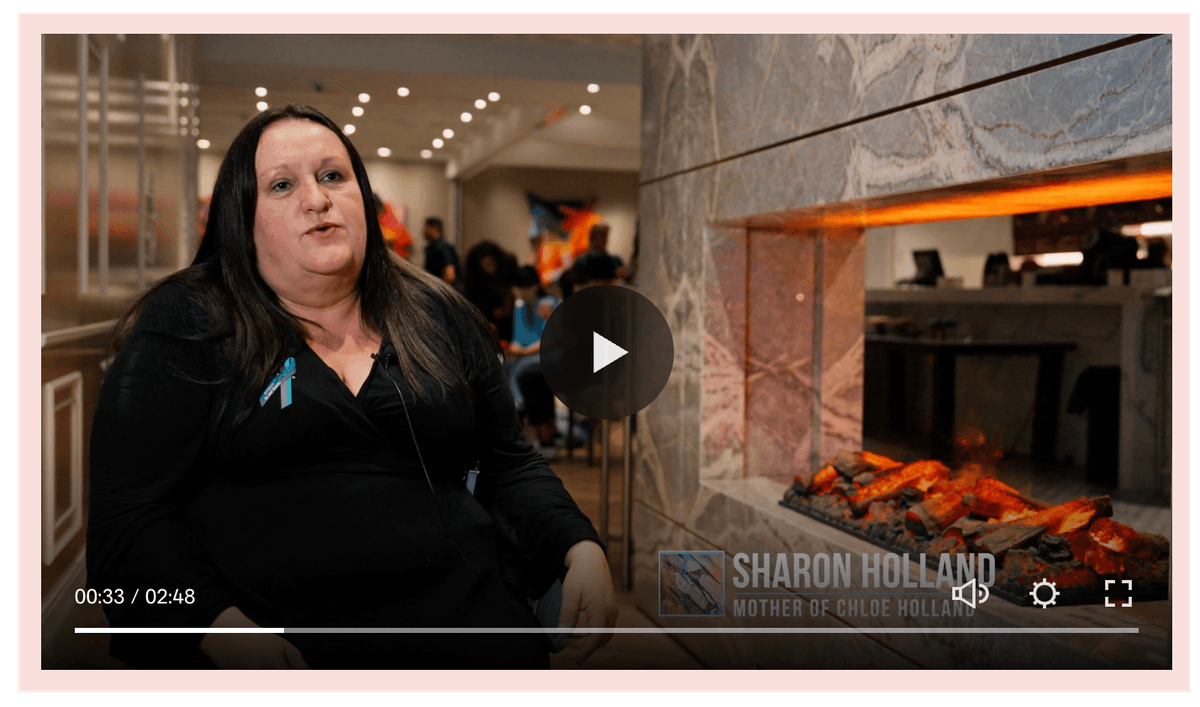
Watch our new Campaign Video and listen to Project Resist's Director Pragna Patel, [Sharon Holland (Her Name Was Chloe Holland Campaign)](https://www.domesticabuserelatedsuicides.org/) and the families themselves explain why our campaign is so urgent.
## Campaign Updates
Following our successful launch of the Suicide is Homicide campaign in October 2025, Project Resist in partnership with [Sharon Holland](https://www.linkedin.com/in/sharon-holland-387aa22a4/) ([Her Name was Chloe Holland Campaign](https://linktr.ee/hernamewaschloeholland)), together with affected families, have been continuing to engage with policy-makers to drive change.
Changes in policing and prosecution are needed in order to ensure justice for those driven to suicide as a result of abuse. Our campaign aims to ensure that every suicide linked to domestic abuse is investigated as a potential homicide.
The launch was covered throughout mainstream media, including the [Guardian](https://www.theguardian.com/society/2025/oct/25/enforce-law-when-suicide-linked-to-domestic-violence-say-uk-campaigners) , [ITV](https://www.itv.com/news/calendar/2025-10-21/calls-for-domestic-abuse-related-suicides-to-be-considered-homicide) and [Sky News](https://youtu.be/Kuw_11zhpq0?si=GAmhd0kGI7R04CD-).
Since the launch, we have had useful meetings with the Crown Prosecution Service and police. Louisa Rolfe, National Policing Lead for domestic abuse, with Kate Brown, Chief Crown Prosecutor and Domestic Abuse lead at the Crown Prosecution Service, and with Graham Ritchie, Deputy Director for strategy and policy at the Crown Prosecution Service have all been receptive to our recommendations for changes to the way that domestic abuse-related suicides are investigated.
We are looking forward to steering further discussions and action to ensure change. This campaign will continue until we see justice for all those affected by this issue.
What can you do?
- Catch up with the campaign launch now on the video above.
- Email comms@projectresist.org.uk to be added to our newsletter list for updates
- Email comms@projectresist.org.uk to add your organisation to our campaign supporters
## Campaign Demands
- A clear and unequivocal recognition in police policy and procedural guidance that suicide in the context of any evidence of domestic abuse may be a potential homicide, i.e. a presumption that any such suicide should be investigated as a potential homicide from the outset until and unless there is clear evidence to rebut that presumption.
- A recognition to a similar effect in CPS policy and guidance in order to ensure that police investigating any such case of suicide receive appropriate support from prosecutors.
- A recognition in sentencing guidelines that, upon conviction of anyone accused of homicide in any such case of suicide, the context of domestic abuse (including coercive and controlling behaviour) should be seen as a particularly egregious aggravating factor attracting an appropriate sentence.
- An explicit commitment in policy and guidance to ensure that links between suicide and domestic abuse are recognised and addressed consistently across the statutory and specialist sectors involved in multi-agency responses to any such case of suicide.
- An educational preventative program across the statutory and specialist sectors to ensure an understanding of the high-risk indictors of suicidal ideation and the concrete steps required to protect a potential victim of such suicide.
- Non-means tested legal aid for the bereaved family in any such case of suicide to ensure they have access to free legal advice and support to help navigate their way through the complex processes of the police investigation and any ensuing criminal prosecution and/or inquest.
- The adequate provision of specialist and holistic advocacy and counselling services to support vulnerable adults to exit from abuse safely and to rebuild their lives free from fear and harm.
For more information please contact comms@projectresist.org.uk
You can read recent news articles about the progress we are making here:
https://www.theguardian.com/society/2026/feb/15/number-uk-women-suicide-domestic-abuse-under-reported-say-experts
https://www.theguardian.com/uk-news/2026/feb/18/calls-grow-suicides-linked-domestic-abuse-treated-potential-homicides
https://www.theguardian.com/uk-news/2026/mar/03/parliament-suicides-domestic-abuse-homicide
## Further Contact & Media
Website links for further information: https://domesticabuserelatedsuicide.org
Her Name Was Chloe Holland links: https://linktr.ee/hernamewaschloeholland

Pragna Patel announced as Visiting Fellow at the London School of Economics
Project Resist's Director Pragna Patel has been announced as a Visiting Fellow at the London School of Economics' Centre for Women, Peace and Security.
The Fellowship will support Pragna's ongoing research and advocacy on violence against minoritised women, the intersection of immigration controls and gender-based violence, and the legacy of grassroots black feminist organising in the UK. We are proud to see her work recognised at this level.

LSE Blog by Pragna Patel
Pragna Patel of Project Resist wrote for the LSE Blog on the legacy of grassroots black feminist organising and the contemporary challenges facing minoritised women in the UK.
The piece situates Project Resist's work within a longer arc of black, brown and migrant women's resistance — and the urgent task of defending hard-won rights against rising authoritarian and patriarchal forces. Read it on the LSE Blog.
.jpg&w=1200&q=75&dpl=dpl_24zXUduh2uAsPZ4wMYniiSbcEcyA)
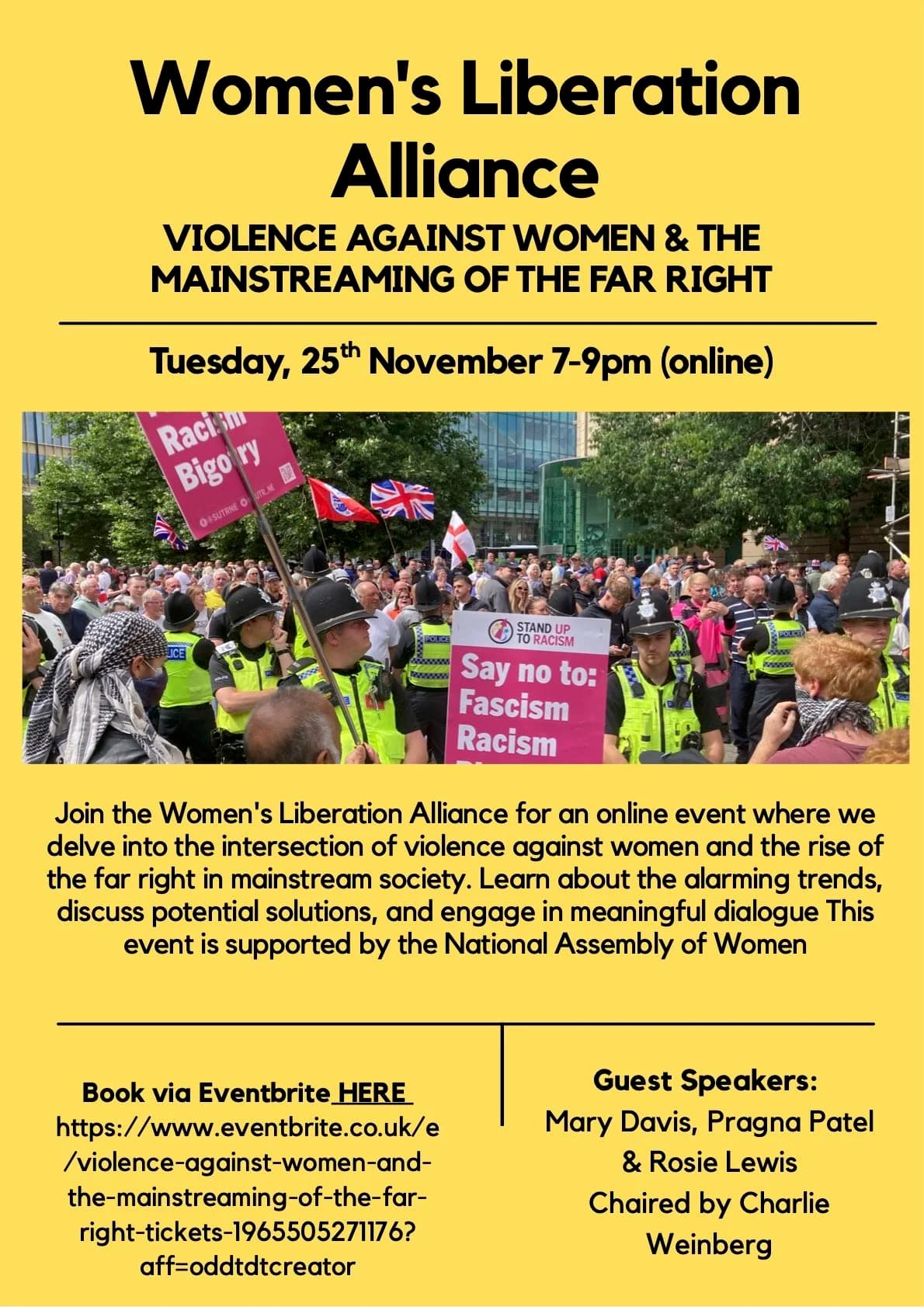
Online Event: Violence Against Women & The Mainstreaming of the Far Right
Online discussion on the intersection of violence against women and the mainstreaming of the far right.

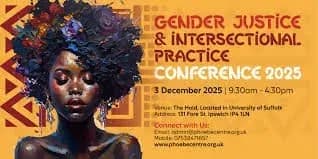
Phoebe Centre Gender Justice Conference
Gender Justice Conference hosted by the Phoebe Centre.

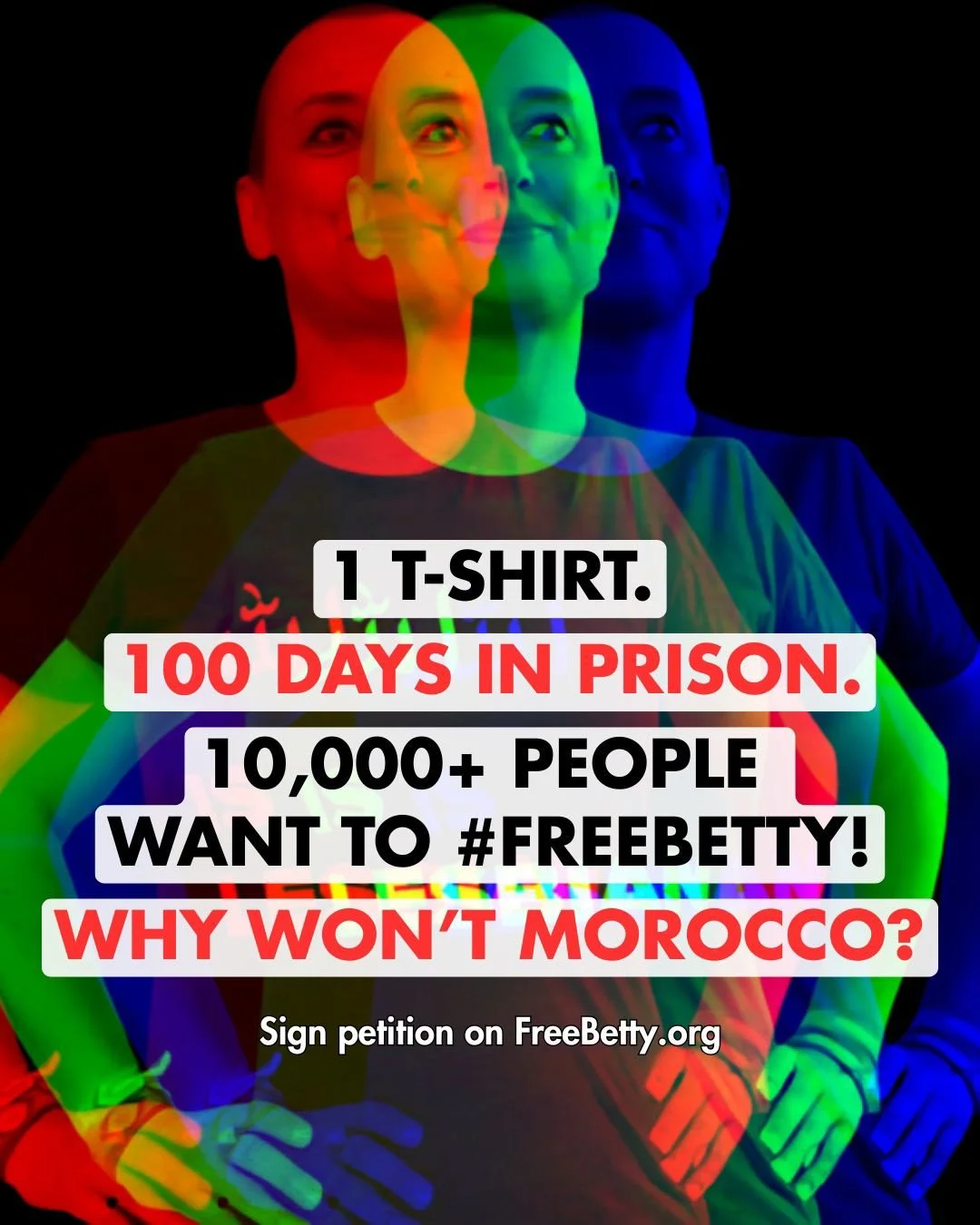
#FREE BETTY: Solidarity with Ibtissame Betty Lachgar
Press Release from the [Council of Ex-Muslims of Britain](https://ex-muslim.org.uk/2025/12/ibtissame-betty-lachgar-a-precedent-that-the-uk-government-cannot-ignore/) (CEMB)
18 November 2025
Today marks 100 days since Moroccan feminist and human rights defender Ibtissame Betty Lachgar was imprisoned in Rabat, Morocco for posting a photograph of herself wearing an “Allah is Lesbian” T-shirt. Her sentence of 30 months stems solely from an act of peaceful expression defending women’s and LGBT rights made outside Morocco.
To mark the 100 days of imprisonment, hundreds of organisations, representing hundreds of thousands of members from around the world have joined the Free Betty Coalition condemning her conviction and calling for her immediate and unconditional release, humane conditions of detention, access to specialised medical treatment, and the repeal of laws restricting freedom of expression.
As a bone cancer survivor, Betty requires urgent treatment and surgery for her arm and prosthesis, otherwise she risks losing it. Her left elbow is completely dislocated now and she is in constant pain. She remains in isolation in a cold cell with no mattress or pillows, being punished for daring to think freely.
Siham Lachgar, Betty’s sister says:
“Today marks 100 days that my sister, Ibtissame Betty Lachgar, has been imprisoned for thinking, speaking, and living freely in pursuit of a fairer world. One hundred days of isolation, pain, and injustice. Her health is deteriorating. She is exhausted and has lost significant weight. This punishment is not about what she has done, but about who she is and what she represents. In Morocco in 2025, thinking differently can still cost you your freedom. It is not my sister who is on trial. It is freedom itself.”
A global push for 100,000 signatures on 18 November
On 18th November, help us reach 100,000 signatures on the petition to free Betty. Every signature strengthens the call for her release and increases pressure to end her mistreatment.
What you can do
* Post #FreeBetty and #100Days across social media.
* Sign and share the petition and find out more on https://freebetty.org/.
Betty’s case is a symbol of the wider struggle for freedom of conscience, bodily autonomy, and the right to challenge patriarchal norms without fear of reprisal.
30 MONTHS FOR A T-SHIRT: A Global Coalition Demands the Immediate and Unconditional Release of Ibtissame Betty Lachgar on the 100th Day of her Incarceration
We, the undersigned organisations, condemn the conviction and imprisonment of Ibtissame Betty Lachgar, a Moroccan feminist and human rights defender sentenced to 30 months in prison for posting a photo of herself wearing a T-shirt reading “Allah is Lesbian” in London on social media.
She had previously worn the T-shirt in 2022 outside Morocco as a statement against the persecution of lesbian women in Iran. The slogan draws from the historic feminist phrase “I saw God. She is black, communist, and lesbian.”
Betty’s imprisonment since 10 August 2025 represents a grave violation of universal human rights. She is detained solely for the peaceful exercise of her freedom of thought and expression. Her conviction under Article 267-5 of the Moroccan Penal Code contradicts Morocco’s obligations under the International Covenant on Civil and Political Rights (ICCPR).
She has been denied urgent medical treatment and held in isolation, contrary to the UN Standard Minimum Rules for the Treatment of Prisoners (Mandela Rules). Authorities have also failed to address the widespread death and rape threats directed at her.
The Free Betty Coalition urges the Moroccan authorities to:
1. Immediately and unconditionally release Ibtissame Betty Lachgar.
2. Apply alternative penalties available under Moroccan law, such as house arrest or public service.
3. Ensure conditions that respect her health and dignity, including an end to isolation and inhumane treatment.
4. Provide urgent and adequate specialised medical care, consistent with international standards.
5. Repeal Article 267-5 of the Penal Code and all provisions restricting freedom of expression.
Signed:
Action, Culture & Émancipation; Against Illiteracy and Poverty; All Out; Altradimora; Association marocaine des droits humains; Atheist & Agnostic Alliance Pakistan; Atheist Refugee Relief; Black Nonbelievers; Bread and Roses TV; California Freethought Day; Center for Civil Courage; Central Council of Ex-Muslims of Scandinavia; Charlie Hebdo; Council of Ex-Muslims of Britain; Council of Ex-Muslims of Germany; Council of Ex-Muslims of Sri Lanka; De Balie; Det norske Hedningsamfunn; Entre les lignes entre les mots; esSENSE Global India; European Network of Migrant Women; Ex-Muslims International, including 24 organisations; Ex-Muslims of North America; Ex-Muslims of Norway; Ex-Muslims of Toronto; Faithless Hijabi; FEMEN; Féminisme et géopolitique; Feminist Dissent; Femmes Solidaires; FiLiA; Fitnah, Movement for Women’s Liberation; Freedom From Religion Foundation; Freethought Lebanon; Freethought Society; Human Rights Tattoo; Humanist Mutual Aid Network; Humanists Sweden; Iniziativa Laica; International Committee against Executions and Stoning; International Feminist Front, including 81 member organisations; Kazimierz Lyszczynski Foundation; Kif Mama Kif Baba; L’Association Nationale des Études Féministes; La Fuerza de Mujeres; Laiques sans Frontieres; Learning through skills acquisition initiative - LETSAI Nigeria; Les Amazones d’Avignon; Ligue du Droit International des Femmes; Livonia Salon; MALI, Mouvement Alternatif pour les Libertés Individuelles Morocco; Manaarah; Marea; MicroMega; Mouvement pour l’émancipation et la liberté de pensée; Muslimish; National Secular Society; Norwegian Humanist Association; One Law for All; Pale Blue Dot Films; Peter Tatchell Foundation; Project Resist; Rainbow Refugee Committee; Regards de femmes; Secularism is a Woman’s Issue; Shuddhashar FreeVoice; Southall Black Sisters; Tallahassee Atheists; The Dissident Club; The Freethinker; The Pensive Quill; Union femmes socialistes; Uniting The Cults; Viva Vegas Project; Women Create International and Women Declaration International.

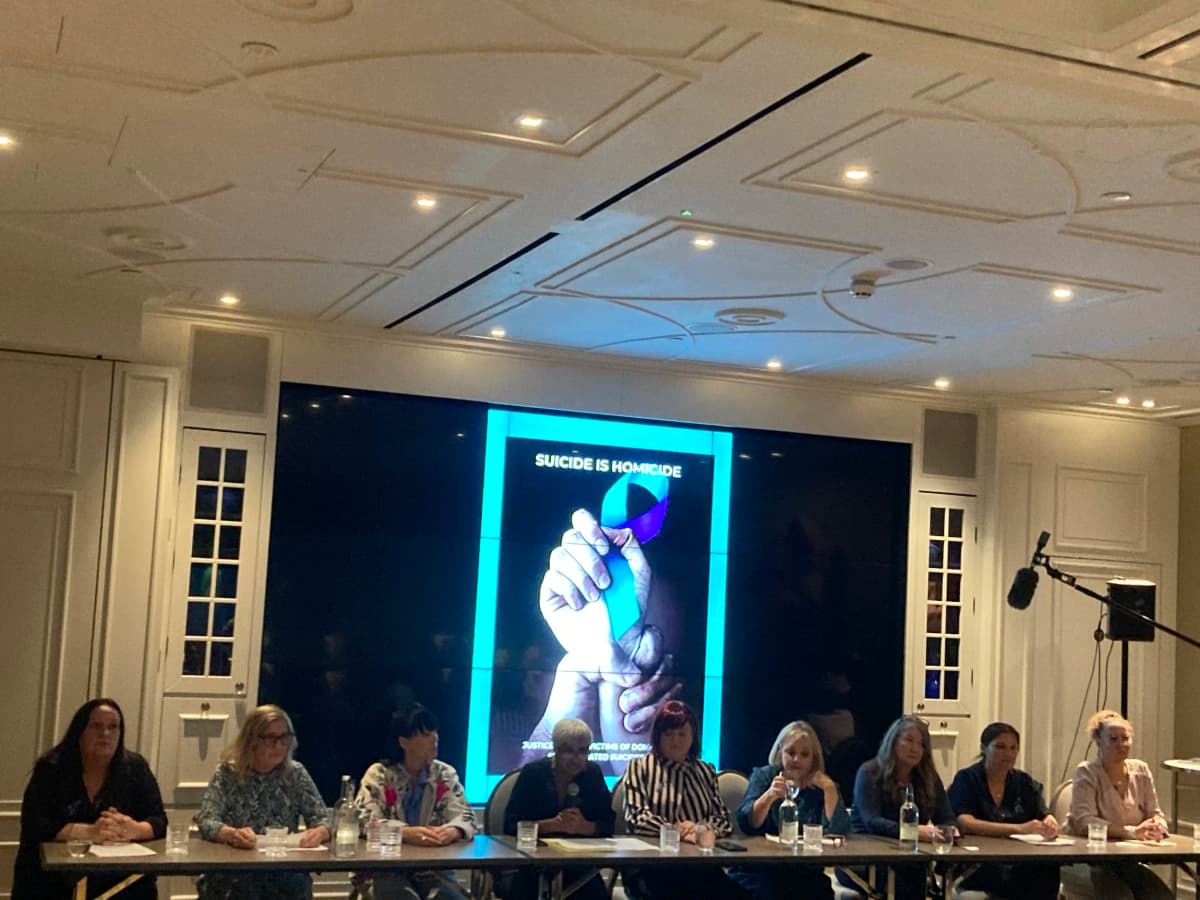
Suicide is Homicide: Campaign Press Conference & Parliamentary Event
## SUICIDE IS HOMICIDE CAMPAIGN
## Justice for all victims of domestic abuse-related suicides
### "No one is stopping and asking why this happened. We shouldn't have to fight so hard for some justice when what happened is this obvious."
These are the words of Rita whose sister Jasmine died in January 2023 against a history of ongoing violence and coercive control by her partner. Throughout her relationship with him, Jasmine was subjected to a catalogue of escalating abuse that included severe sexual violence involving rape and attempted strangulation, and she reported him repeatedly to the police, telling them that he was extremely dangerous. Matters came to a head when he told Jasmine to "go hang herself to make everyone's life better". She was found hanging in her home the next day, but there was a complete failure by the police and inquest system to investigate her death as a domestic abuse related suicide.
It is estimated that three women die each week from suicide due to experiencing domestic abuse, and the numbers appear to be rising. According to the latest figures released by the Domestic Homicide Project funded by the Home Office and led by the National Police Chiefs' Council (NPCC) using live police records – there were 1,012 domestic abuse-related deaths (male and female) in England and Wales between 2020 and 2024, of which 354 were suspected suicides compared to 332 recorded homicides. Over the 12 months from 1 April 2023 to 31 March 2024, there were 98 suspected suicides compared to 80 recorded homicides. Over the preceding 12 months, there were 93 suspected suicides compared to 83 recorded homicides. The pattern is clear: for the first time, death by suicide appears to have overtaken intimate partner homicides.
### The Campaign
Bereaved families from diverse backgrounds have come together with Project Resist to build a campaign demanding justice for loved ones who have taken their lives in the context of domestic abuse (including coercive and controlling behaviour). Testimonies from the families highlight systemic and ongoing failures on the part of the police, the wider criminal justice system and other agencies: failures to investigate their loved ones' domestic abuse related suicides as potential homicides, following failures to adequately protect and support them whilst alive.
### The Failure of the Criminal Justice System
The families' testimonies reveal disturbing themes of indifference and neglect on the part of the police in their investigations following a domestic abuse related suicide.
Two related issues have clearly emerged: a failure to investigate wider histories of domestic abuse because of a failure to recognise underlying dynamics of abuse and coercive control; and a consequent failure to conduct a thorough investigation of a death as a potential homicide, leading to a failure to consider charges of manslaughter where appropriate.
At best families, of both female and male victims, may see charges of coercive control brought against the abusers, often belatedly following inquests: charges which fail to reflect the gravity of the offending behaviour and its impact on victims.
Families often have to wait for years for the state to account for such failures, and it is usually too late by then to put them right.
The real issue is not any lack of police powers or gaps in the criminal law. As acknowledged by the National Police Chiefs' Council lead on domestic abuse - Assistant Commissioner Louisa Rolfe of the Metropolitan Police - investigators miss obvious patterns of coercive and controlling behaviour in too many cases: "It's very clear that there is more for us to do, to be really curious about what's happened, to ensure that evidence at the scene of an incident is very thoroughly captured and explored."
This recognition of the prevalence of police mishandling of domestic abuse-related suicides is welcome but it is not enough. Lessons learnt from countless Domestic Homicide Reviews tell us that the failure of the police to be 'really curious about what's happened' is not the whole problem. Rather, we are faced with serious structural and systemic issues around responses to domestic abuse and coercive control.
### Justice and the Inquest System
Historically, the specific form of violence against women and men seen in cases of domestic abuse related suicides has always been ignored or inadequately addressed by the criminal justice system because of entrenched indifference, neglect and a culture of refusal to investigate on the part of the police. As a result, bereaved families have had to use the inquest system in order to seek some semblance of scrutiny of the circumstances in which their loved ones may have died. However, even that is subject to sound legal advice and representation, and the quality of scrutiny brought to bear can vary considerably: all too often, a coroner will restrict the remit of the inquest narrowly, with the focus on how and not why the victims took their lives.
Inquest outcomes concerning the tragic deaths of Jessica Laverack (2022), Roisin Hunter Bennett (2022) and Kellie Sutton (2024) - where a ground breaking conclusion of unlawful killing was returned – and the recent case of Keina Dawes (2025) have done much to bring to recent public attention, not only the links between suicide and domestic abuse, but also the fact that many bereaved families continue to feel badly let down by the criminal justice system.
Too many victims and their families are seriously failed and will continue to be failed unless the demands of this campaign are properly addressed.
### Campaign Demands
- A clear and unequivocal recognition in police policy and procedural guidance that suicide in the context of any evidence of domestic abuse may be a potential homicide, i.e. a presumption that any such suicide should be investigated as a potential homicide from the outset until and unless there is clear evidence to rebut that presumption.
- A recognition to a similar effect in CPS policy and guidance in order to ensure that police investigating any such case of suicide receive appropriate support from prosecutors.
- A recognition in sentencing guidelines that, upon conviction of anyone accused of homicide in any such case of suicide, the context of domestic abuse (including coercive and controlling behaviour) should be seen as a particularly egregious aggravating factor attracting an appropriate sentence.
- An explicit commitment in policy and guidance to ensure that links between suicide and domestic abuse are recognised and addressed consistently across the statutory and specialist sectors involved in multi-agency responses to any such case of suicide.
- An educational preventative program across the statutory and specialist sectors to ensure an understanding of the high-risk indictors of suicidal ideation and the concrete steps required to protect a potential victim of such suicide.
- Non-means tested legal aid for the bereaved family in any such case of suicide to ensure they have access to free legal advice and support to help navigate their way through the complex processes of the police investigation and any ensuing criminal prosecution and/or inquest.
- The adequate provision of specialist and holistic advocacy and counselling services to support vulnerable adults to exit from abuse safely and to rebuild their lives free from fear and harm.
### Family Endorsement
This campaign is supported by the following families whose loved ones took their own lives having experienced domestic abuse and coercive control:
1. Sharon Holland (mother of Chloe Holland, date of death 6.3.23)
2. Rachel Whiting (sister of Sarah Jane Whiting, date of death 12.4.23)
3. Debbie Hood (mother of Kerry Louise Hensby, date of death 9.8.20)
4. Pamela Taylor (mother of Kellie Marie Sutton, date of death 26.8.17)
5. Phyllis Daly (mother of Jessica Laverack, date of death 2.2.18)
6. Asha Jackson (sister of Zoe McDonald, date of death 7.1.23)
7. Sinead Gibson (mother of Diva Gibson, date of death 10/05/2020)
8. Teresa Hunter (mother of Matthew Dudley Hunter, date of death 16.10.21)
9. Philippa (sister of Richard Barker, date of death 2.9.19)
10. Nikki Crookes (mother of Louie Powell, date of death 21.11.21)
11. Margaret Hunter (mother of Roisin Hunter Bennett, date of death 16.3.22)
12. Jackie (mother of Louise, date of death 06.11.2018)
13. Sarah Wingrove (sister of Leanne Allen, date of death 23.4.23)
14. Sharon Walker (mother of Rachel Louise Walker, date of death 15.3.20)
15. Andi Wilkinson (mother of Kara-Leigh Wilkinson, date of death 5.8.23)
16. Helen Simpson (mother of Demi Hannaway, date of death 13.5.21)
17. Donna Gibney (mother of Ashleigh Louise Inskip, date of death 06.07.2021)
### This Campaign is Supported by:
1. Advance
2. Angelou Centre
3. Apna Haq
4. Ashiana Network
5. Asian Women's Resource Centre
6. Aurora New Dawn
7. Basira
8. Centre for Women's Justice
9. Changing Pathways
10. Createful (Portsmouth)
11. Cris McCurley: Solicitor - Ben Hoare Bell Solicitors
12. Crossroads Derbyshire
13. Dr Jane Krishnadas; Convenor of CLOCK (Community Legal Outreach Collaboration, Keele), Senior Lecturer in Law, Keele University.
14. East Surrey Domestic Abuse Services
15. Gilgal
16. Hull Sisters
17. Humraaz
18. IDAS
19. Idle Women
20. IKWRO
21. Independent Choices Great Manchester
22. Jewish Womens Aid
23. Juno Women's Aid
24. Karma Nirvana
25. Key Charity
26. Leeds Women's Aid
27. Lotus Domestic Abuse Recovery Programme
28. Men's Share Listening Group - Crawley
29. Mercia Women's Aid
30. Middle Eastern Women and Society Organisation – MEWSO
31. My CWA Cheshire
32. My Sisters Place
33. My Sisters' House Women's Centre
34. NDAS (Northumberland Domestic Abuse Service)
35. NE Lincolnshire Women's Aid
36. Oasis Domestic Abuse Service
37. On Eggshells
38. One Law for All and CEMB
39. Pathway Project Lichfield
40. Professor Mary Davis
41. Raggi Kotak Barrister, One Pump Court Chambers
42. Rahila Sharif, Ending VAWG Consultant
43. Rise UK
44. Rising Sun Domestic Violence and Abuse Service
45. Rochdale Women's Welfare Association (RWWA)
46. Safe in Sussex
47. Safety4Sisters North West
48. Saheli
49. Salford Women's Aid
50. Sangini
51. SATEDA
52. Sheffield Women's Aid
53. Solace Women's Aid
54. Southall Black Sisters
55. Staffordshire Women's Aid
56. Staying Put
57. Stepping Stones Luton
58. Sutton Women's Centre
59. The First Step
60. The Pankhurst Trust incorporating Manchester Women's Aid
61. Tim Woodhouse, Churchill Fellow, Suicide Prevention Researcher
62. Tina's Haven
63. Trafford Domestic Abuse Service
64. Ubuntu Women Shelter
65. UK Ex Female Prisoner's Project
66. Vida Sheffield
67. We are Survivors
68. Wearside Women in Need
69. Woman's Trust
70. Women's Budget Group
71. Women's Resource Centre
72. Wycombe Women's Aid
73. Yasmin Rehman, Feminist Human Rights Activist
74. Your Sanctuary
Contact & Media
For further information please contact: comms@projectresist.org.uk
Website links for further information: https://domesticabuserelatedsuicide.org
Her Name Was Chloe Holland links: https://linktr.ee/hernamewaschloeholland
Project Resist's Website: www.projectresist.org.uk

FiLiA Conference October 2025
Project Resist participated in the FiLiA Conference 2025, Europe's largest annual feminist gathering.
Project Resist members spoke on panels covering racialised violence, the rise of the far right, and the legacy of grassroots black feminist organising across the UK.

Launch of New Report: "Why do I have to hide away?"
## POLICY, BRIEFINGS, REPORTS
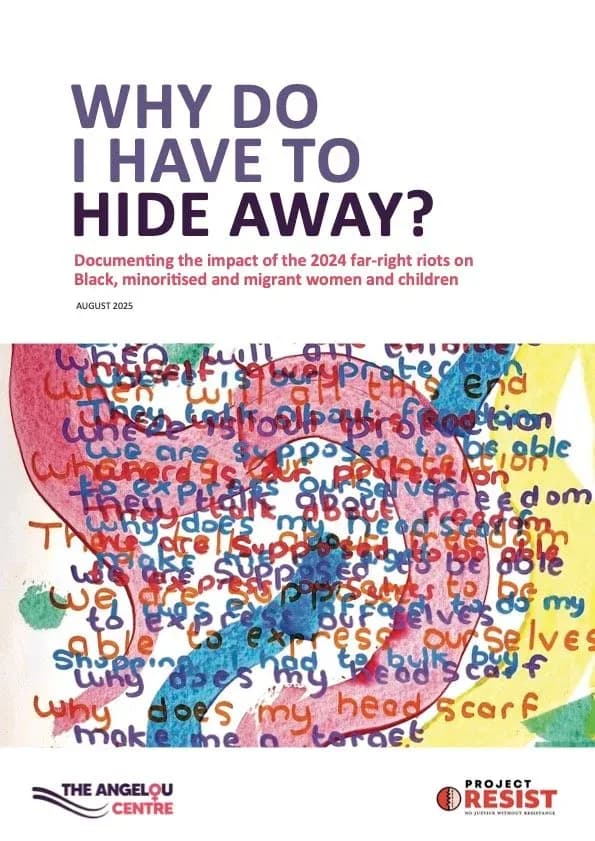
Why do I have to hide away? documents the devastating impact of the 2024 far-right riots on Black, migrant and minoritised women and children. Based on research conducted between October 2024 and May 2025, the report presents the first full length study into the traumatic lived experiences of women and children in the wake of the riots and "gendered racism".
Written and researched by Project Resist in collaboration with the Angelou Centre, Why do I have to hide away? serves as an urgent response to the devastating racist, anti-migrant, anti-Muslim and anti-minorities riots that shook the UK in summer 2024. Rooted in the lived experiences of Black, minoritised and migrant women, children and young people, the report makes a compelling intervention in debates surrounding the widespread social upheaval that has followed, illuminating how racist and far right populist rhetoric fuels both racial violence and misogyny. As an integral part of the broader Angelou Centre's wider Stories of Colour project, the research centres the voices of those most affected by the riots and uncovers the multi-faceted ways in which the events have impacted on the security and safety of women and children while reflecting on what this means for anti-racist resistance.
[Download the full report here.](https://www.projectresist.org.uk/s/why_do_I_have_to_hide_away-1.pdf)
Media coverage of the report can also be accessed here:
https://www.bbc.co.uk/news/articles/cvgn3y4z3g4o

Feminist Dissent Issue #8 — SOAS Launch Event
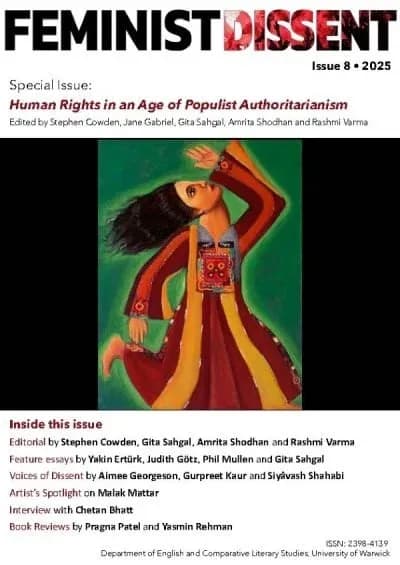
Feminist Dissent published Issue #8: "Human Rights in an Age of Populist Authoritarianism", with contributions from Project Resist members and allies.
The issue was launched at SOAS, University of London, with a panel discussion on the contemporary threats to women's rights from populist and authoritarian movements.

Feminist Dissent Issue #8: Human Rights in an Age of Populist Authoritarianism
Announcing Issue #8 of Feminist Dissent: Human Rights in an Age of Populist Authoritarianism, plus a SOAS event.

One Year on from the Far-Right Riots — Project & Research Launch
Stories of Colour: a survivor-led call to action one year on from the 2024 far-right riots.

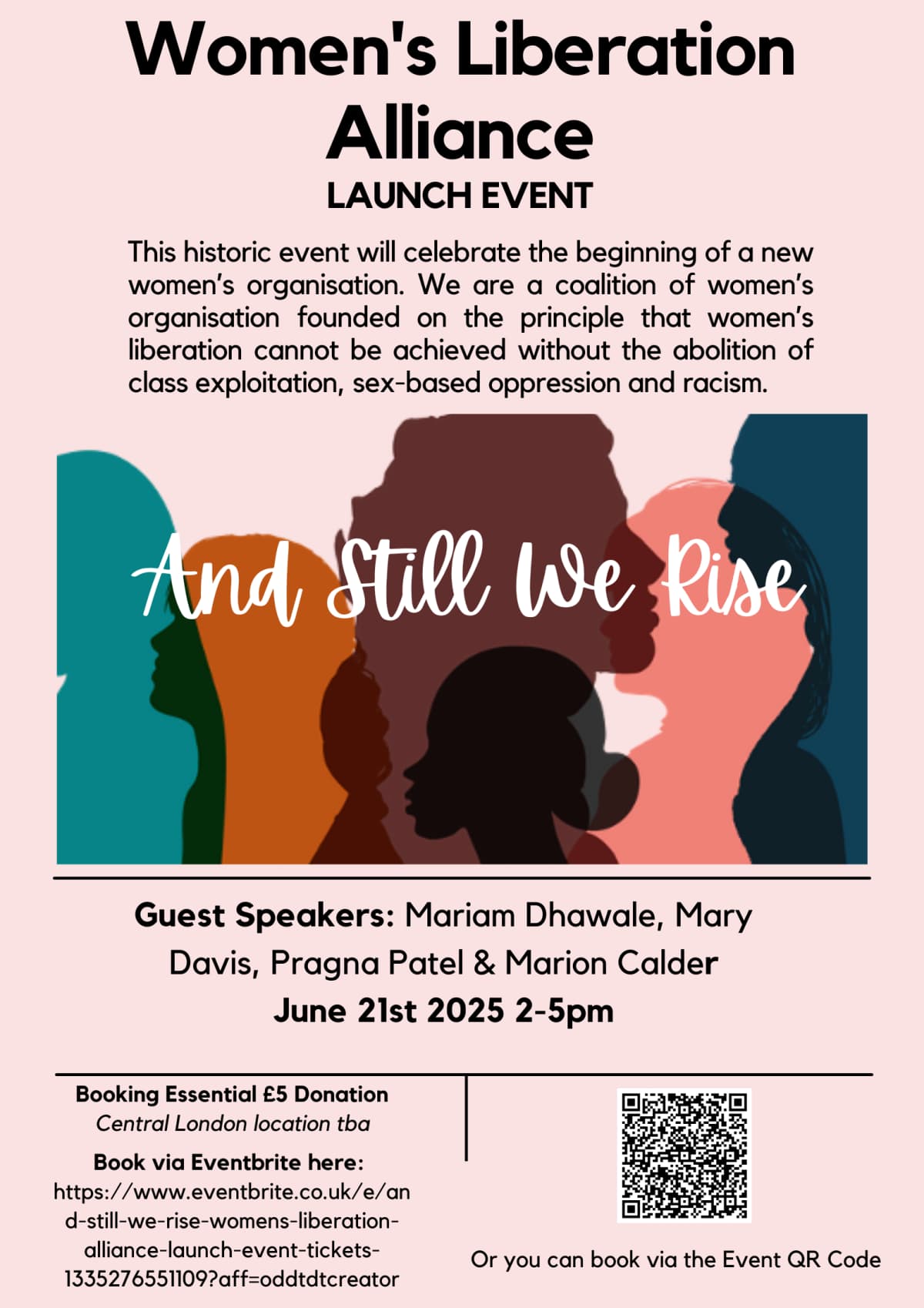
And Still We Rise: Launch of Women's Liberation Alliance
Project Resist joined the launch event for the Women's Liberation Alliance, a new feminist coalition organising against the rollback of women's rights.
The event brought together speakers from across the women's sector to share strategy and solidarity.

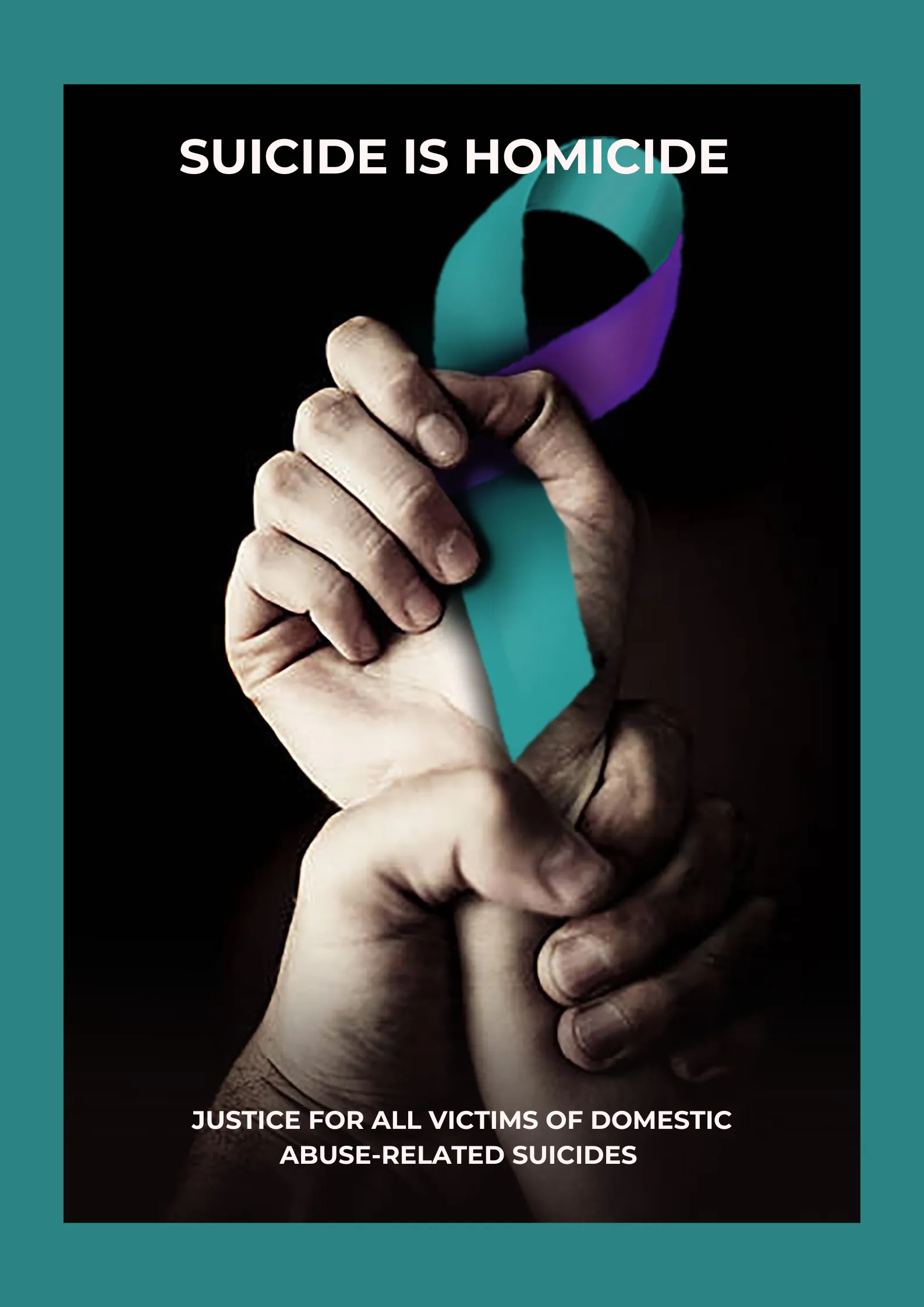
Suicide is Homicide Campaign Launch
Launch event for the Suicide is Homicide campaign demanding recognition of domestic abuse-related suicide as potential homicide.
.jpg&w=1200&q=75&dpl=dpl_24zXUduh2uAsPZ4wMYniiSbcEcyA)
Gender-Based Violence Across Borders Conference
Project Resist contributed to the Gender-Based Violence Across Borders Conference at Northumbria University.
The conference brought together researchers, practitioners and survivors to examine how migration, citizenship and immigration controls shape women's experiences of violence and access to justice.

Recognising Coercive Control in Counter-Allegations: VAWG Sector Briefing
Project Resist and Rights of Women brought together VAWG organisations to examine how UKVI’s handling of counter-allegations is negatively impacting migrant women victim-survivors of domestic abuse applying for settlement. A briefing was produced outlining concerns and recommendations for change.
Earlier, this year, the Violence Against Women and Girls (VAWG) sector came together to discuss its concerns with the Home Office (UKVI) approach to assessing domestic abuse in immigration cases involving counter-allegations.
Counter- allegations in the context of domestic abuse including coercive control arise when both parties of the relationship allege the other has been abusive. Counter-allegations can be falsely made by perpetrators to deflect responsibility or further their abuse. They can also arise when victims engage in defensive or protective behaviours in response to their abuse.
Coordinated by Project Resist and Rights of Women, VAWG sector organisations met to discuss how this issue was affecting migrant victims of domestic abuse applying to the Home Office (UKVI) for settlement. We produced a briefing addressing our concerns with how the Home Office (UKVI) currently deals with these issues, and made recommendations for change which you can read here: [VAWG-sector-briefing-on-counter-allegations-02.04.25.pdf](https://www.rightsofwomen.org.uk/wp-content/uploads/2025/04/VAWG-sector-briefing-on-counter-allegations-02.04.25.pdf)
Project Resist’s work on UKVI assessments of counter-allegations in the immigration system forms part of our wider work on counter-allegations in contexts of domestic abuse and coercive control and the criminalisation of women in the criminal justice system.
.jpg&w=1200&q=75&dpl=dpl_24zXUduh2uAsPZ4wMYniiSbcEcyA)
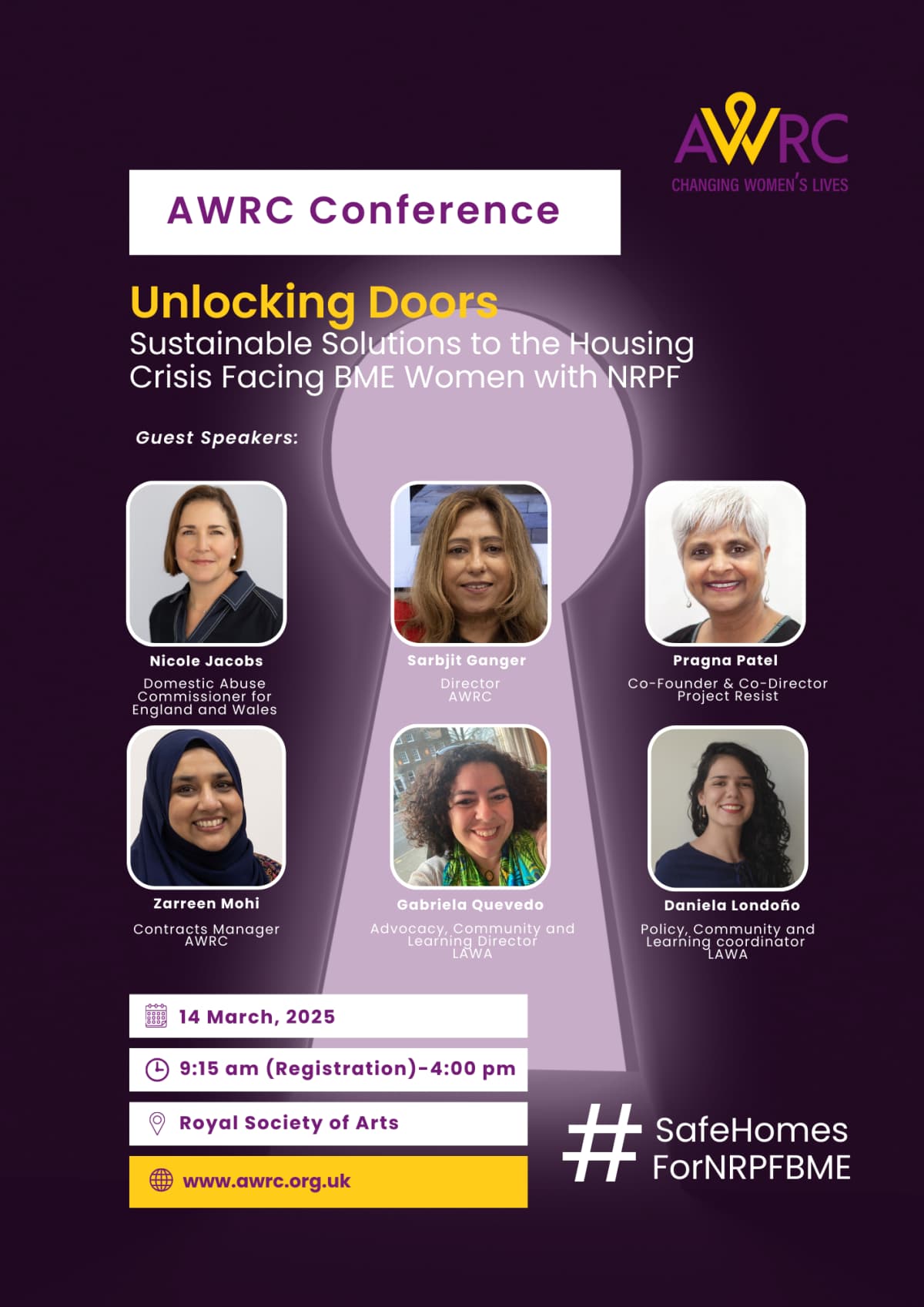
AWRC Conference
Project Resist's co-director Pragna Patel spoke at the Asian Women's Resource Centre (AWRC) conference, "Unlocking Doors: Sustainable Solutions to the Housing Crisis for BME Women with No Recourse to Public Funds (NRPF)", held at the Royal Society of Arts on 14 March 2025.
Bringing together experts, advocates, policymakers and survivors, the conference addressed the housing crisis facing BME women with NRPF status. Pragna highlighted that for many such women, escaping abuse is only the beginning: without access to benefits, refuge spaces or stable housing, they face an impossible choice between homelessness and staying with their abuser.

ILPA Conference on Current Issues in Immigration & Family Law
Project Resist contributed to the Immigration Law Practitioners' Association (ILPA) conference on current issues in immigration and family law.
The session focused on the experiences of migrant women survivors navigating both immigration controls and the family courts.

Building Solidarity: New Guest Blog Feature
Project Resist launches a new guest blog feature to build solidarity across the women's sector.

Improving Access to Justice in Bradford
Community event in Bradford on improving access to justice for women.

Resilient Democracy Conference
Conference on building and sustaining democratic resilience.

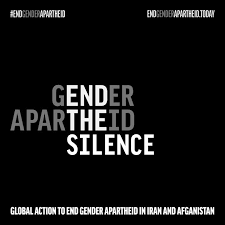
Gender Apartheid: A Crime Against Humanity — Parliamentary Event
PRESS STATEMENT: by The International Bar Association's Human Rights Institute (IBAHRI), One Law for All and Project Resist. For Immediate Release 3 March 2025
Gender Apartheid: A Crime Against Humanity – International Women’s Day Event at the House of Lords Calls for Global Action
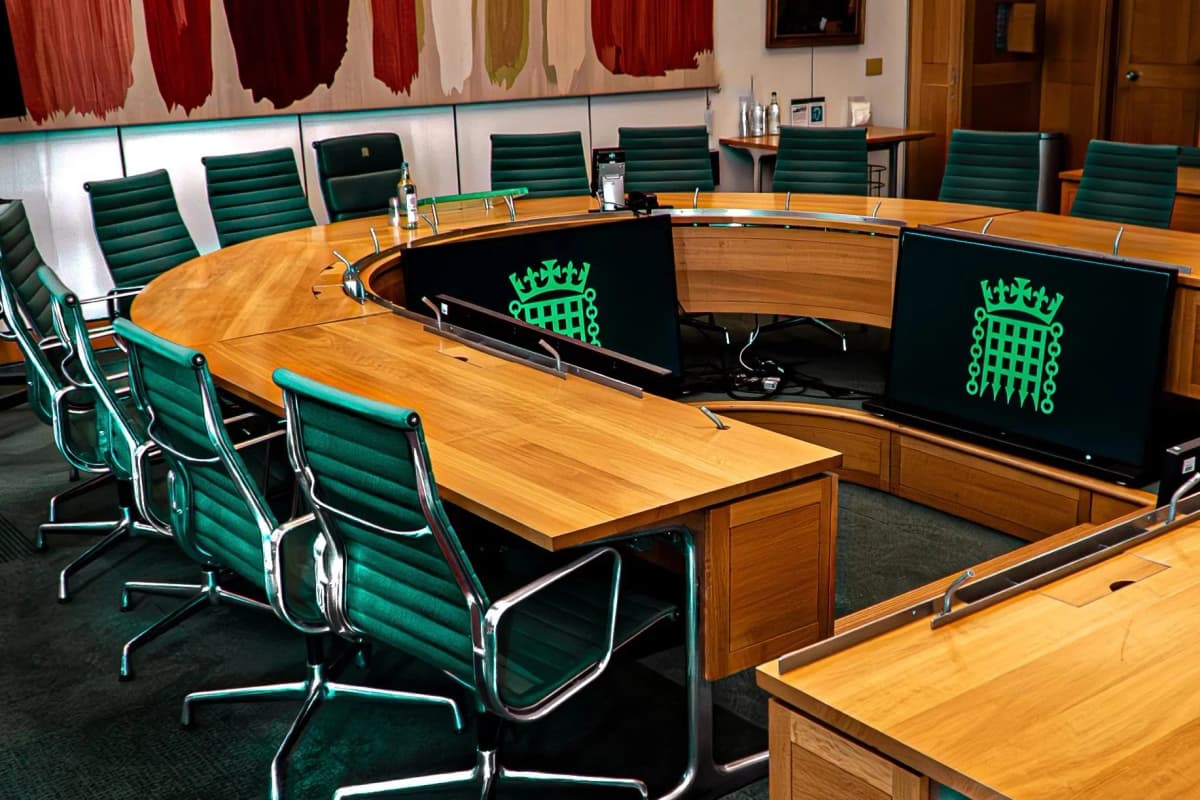
Date: Thursday 6 March 2025 Time: 14:00 (for a 14:30 start) – 17:00 Venue: Committee Room 4A, Houses of Parliament, London
[London] – In the lead-up to International Women’s Day, a powerful gathering of activists, legal experts, judges, and artists at the House of Lords will call for gender apartheid to be recognised as a crime against humanity.
The event will be chaired by leading human rights barrister Helena Kennedy KC and will feature a panel of prominent voices: Actress Ariane Hejazi, former senior judge of the Supreme Court of Afghanistan and head of the Violence Against Women Court Fawzia Amini, former Afghan civil judge Ferozan Easar Qasimi, One Law for All Spokesperson Maryam Namazie and Co-Founder of Project Resist Pragna Patel.
Fawzia Amini says: ‘Gender apartheid denies women basic freedoms, treating equality as a privilege rather than a right.’
The sold-out event will highlight the urgent need for global action against regimes in Afghanistan and Iran that systematically oppress and erase women from public life.
Pragna Patel says: ‘The gains that have been made for women’s freedom and equality are being wiped out everywhere. But in countries such as Afghanistan and Iran, women are not just facing the most egregious discrimination: they are being literally erased out of existence by the use of gender apartheid as an instrument of oppression.’
Despite the grave human rights violations committed under gender apartheid, the international response has been weak—a stark contrast to the strong global action that helped end racial apartheid in South Africa.
Maryam Namazie says: ‘Sex apartheid like racial apartheid is dehumanising, degrading and humiliating. It’s violent and akin to modern day witch hunts and lynchings. It has been excused and even legitimised for far too long because of cultural relativism and the historical and ongoing disregard for crimes against women.’
This event is a call to action for policymakers, human rights defenders, and the global community to recognise gender apartheid as a crime against humanity and demand justice for millions of women.
Ariane Hejazi says: ‘Holding perpetrators accountable is not only a legal obligation but a moral imperative.’
Ferozan Easar Qasimi says: ‘This event honours Afghan judges who faced exile and Iranian activists who risk everything for freedom while fighting for justice.’
Helena Kennedy KC underscores the urgency: ‘Women and girls in Afghanistan and Iran are disappearing from public life. They are denied education, work, and even the right to move freely. This is a grievous situation—one that meets the very definition of apartheid. We must recognise gender apartheid as a crime and push the international community to act decisively.’
Internationally acclaimed films—The Red Suitcase (Short 2022), Rise (Short 2023), and Bread and Roses (Trailer 2024) will be featured —as well as a Daf performance by percussionist Sara Fotros and music by Kurdish/Alevi singer Suna Alan.
Sponsored by the International Bar Association’s Human Rights Institute, One Law for All, and Project Resist.
For media inquiries and further information, please contact: 📧 genderapartheidevent@gmail.com

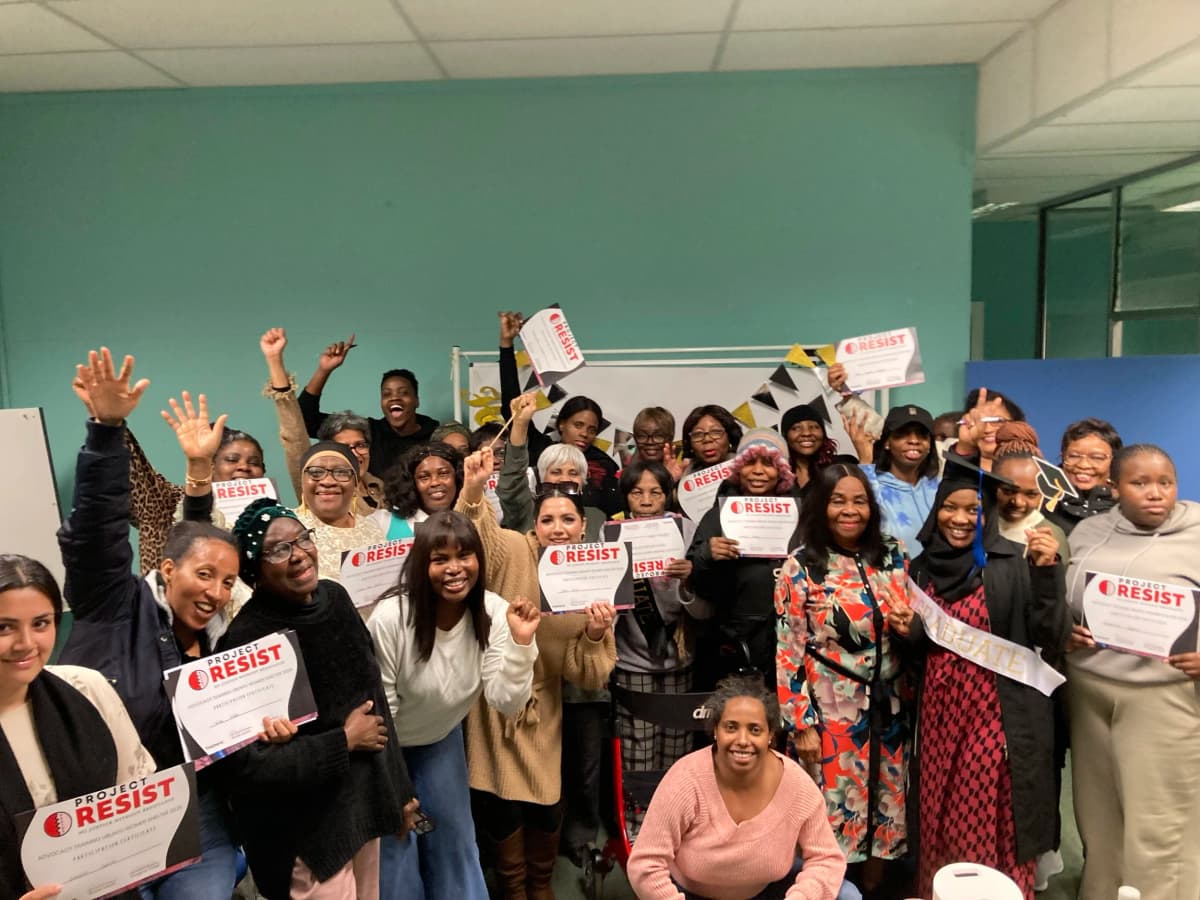
Resistance Training — Ubuntu Women Shelter (Glasgow)
Project Resist delivered a Resistance Training session for grassroots organisers and frontline practitioners, co-hosted by Ubuntu Women Shelter in Glasgow.
The training covered campaign building, media advocacy and survivor-led organising in the context of hostile immigration policy.

Measuring the Impact of the Far-Right Riots: Submission to the Women & Equalities Committee
Project Resist made a written submission to the Women and Equalities Committee's inquiry into community cohesion following the 2024 far-right riots.
The submission documented the gendered impact of the riots on minoritised women and called for an intersectional response from local and national government.

Independent Sentencing Review: Project Resist Submission
by Pragna Patel
Project Resist has made a submission to the Independent Sentencing Review. (January 2025) on black and minority women’s experiences of sentencing in the criminal justice system. While we welcome the present government’s commitment to divert women away from custodial sentences, we remain concerned about the delivery of this commitment in the absence of effective legislative changes to homicide laws and proper financial, legal, housing and other support so that women and their children have a fair chance at integration and rehabilitation.
We are also signatories to an open letter calling for an end to the punishment of women who are survivors of domestic abuse. See [Women in Prison — Stop Punishing Domestic Abuse Survivors](https://womeninprison.org.uk/campaigns/stop-punishing-domestic-abuse-survivors).

Resist Network Training (November 2024)
Project Resist convened a training and strategy session for the ten member organisations of the Resist Network.
The session focused on shared campaigning priorities for 2025, including the Suicide is Homicide and Double Injustice campaigns.

Solidarity With the Women of Iran
by Pragna Patel
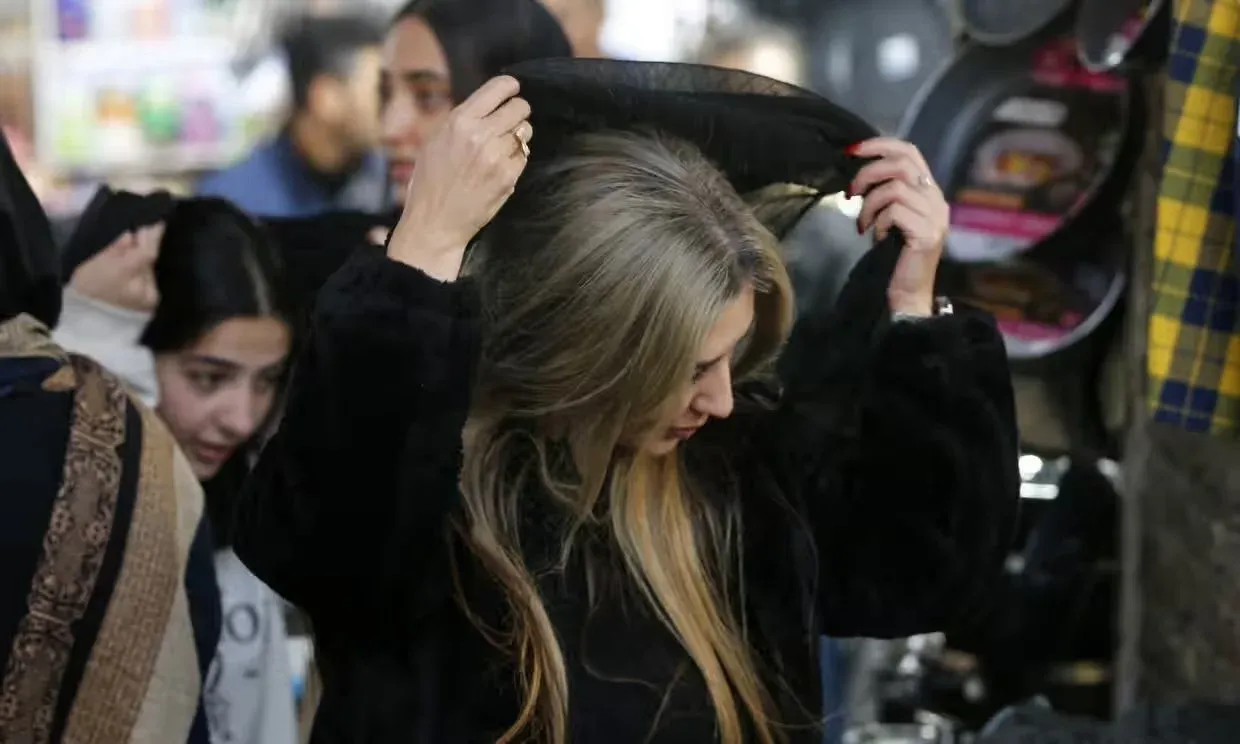
On 8 November 2024, Project Resist joined other women in protest against the brutality of the fundamentalist Iranian regime organised in London by One Law For All and FEMEN. We stood in solidarity with Ahoo Darhyae and the women of Iran. Ahoo Darhyae is the latest in a long line of women beaten and arrested by the Iranian police for dissenting against the imposition of the hijab. We stand against the daily assaults, denigration and torture of women that is taking place and endorsed by fundamentalist power not just in Iran but worldwide:
“Globally a war is being waged against women – from Iran, Afghanistan to the post-Dobbs USA now under Trump and his Project 2025 agenda. On Friday 8 November, I stood in solidarity with my brave sisters from Iran and elsewhere to mourn the detention and most likely torture of Ahoo Daryae, and to lend my voice to the growing movement for the liberation of Iranian women whose bodies have become instruments of resistance. Whenever and wherever women are subject to social control and power, they have fought back with their bodies inscribed with the battle cry: ‘Our bodies, Our Choice’. If history has taught us anything it is that we will use our bodies to insert ourselves in spaces where we are being actively suppressed and oppressed. Our bodies embody our spirit, our lives and our freedom. We will take back control.“ (Pragna Patel)
For more details see also: [Global Day of Action to Defend Ahoo Daryaei a Huge Success | Council of Ex-Muslims of Britain - CEMB](https://ex-muslim.org.uk/2024/11/global-day-of-action-to-defend-ahoo-daryaei-a-huge-success/)
See also [Iranian women could face death penalty for defying new morality laws | Women's rights and gender equality | The Guardian](https://www.theguardian.com/global-development/2024/dec/11/iranian-women-death-penalty-jail-fine-defy-new-morality-hijab-improper-dressing-islamic-penal-code)
.jpg&w=1200&q=75&dpl=dpl_24zXUduh2uAsPZ4wMYniiSbcEcyA)
National Black Crown Prosecution Association (NBCPA) Conference
Project Resist's co-director Pragna Patel spoke at the National Black Crown Prosecution Association (NBCPA) conference in Birmingham, where she ran a workshop exploring the experiences of black and minority women in the criminal justice system in the context of violence against women and girls.

Gender Justice & Intersectional Practice Conference 2024
by Pragna Patel
On 29 November 2024, Project Resist took part in a major conference entitled ‘Gender, Justice and Intersectional Practice’ organised by the Phoebe Centre in Ipswich during 16 Days of Activism Against Gender Based Violence. The focus was on sharing ideas and experiences in support of black and minoritised and migrant women subject to a range of harms and discrimination. Pragna Patel gave a keynote speech on migrant women’s journey towards justice in the context of domestic abuse in the UK since the 90s. She also chaired and participated in a panel discussion comparing legal remedies and good practice established for the purposes of protecting and progressing migrant women’s rights in the US and the UK. See here: [Ipswich charity Phoebe hosts gender justice conference - BBC News](https://www.bbc.co.uk/news/articles/cqlrn5q413yo)

Humanists UK: Faith to Faithless Conference
Groundbreaking conference examining the lasting impact of religious abuse.

CPS: In Conversation — South Asian Heritage Month
Project Resist contributed to the Crown Prosecution Service's "In Conversation" event for South Asian Heritage Month.
The discussion focused on the prosecution of violence against South Asian women, including the unique evidential and cultural challenges these cases raise.

Feminist Dissent & Project Resist: Opposition to Far-Right Terror
Blog by Feminist Dissent
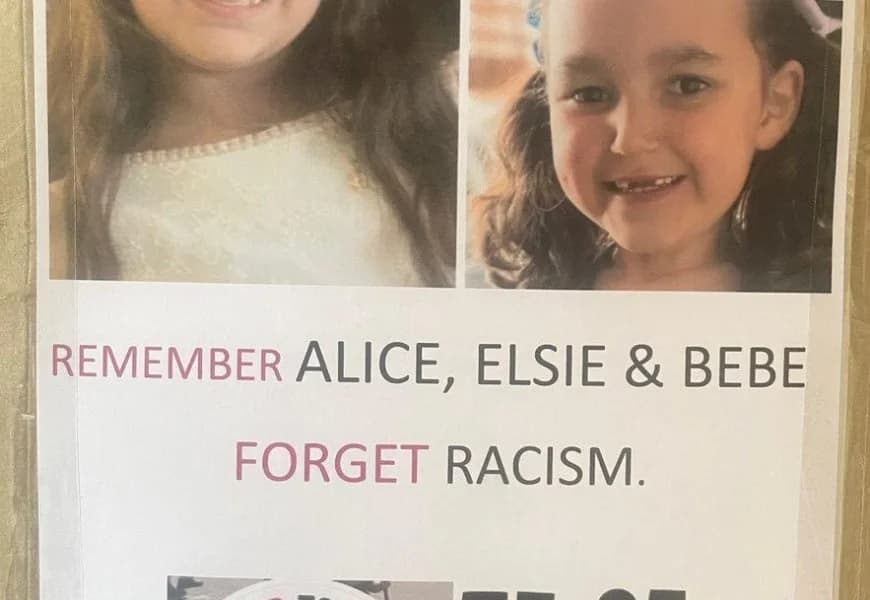
We are horrified at the murder of three young girls that took place in [Southport on Monday 29 July](https://crisis24.garda.com/alerts/2024/07/uk-response-continuing-after-stabbing-in-southport-july-29-update-1). Our whole-hearted thoughts go to their families and those that knew them. This incident is a horrific tragedy that must be seen in the context of violence against women and girls (VAWG). As with other incidents in recent years, the murders of Nicole Smallman, Zara Aleena, Bibaa Henry, Sarah Everard, Ellie Gould and Alice Ruggles, we have seen media outrage but a lack of willingness to identify this as primarily an issue of male violence. [The National Police Chiefs Council’s (NPCC’s) report declared VAWG a national emergency](https://news.npcc.police.uk/releases/call-to-action-as-violence-against-women-and-girls-epidemic-deepens-1#:~:text=The%20National%20Policing%20Statement%20for,37%25%20between%202018%2F23.) less than a week before the Southport murders. Organisations dealing with violence against women have long been raising the alarm bells that this national threat has not been sufficiently prioritised, neither addressed through meaningful action or accountability, nor received the investment needed to address and end it.
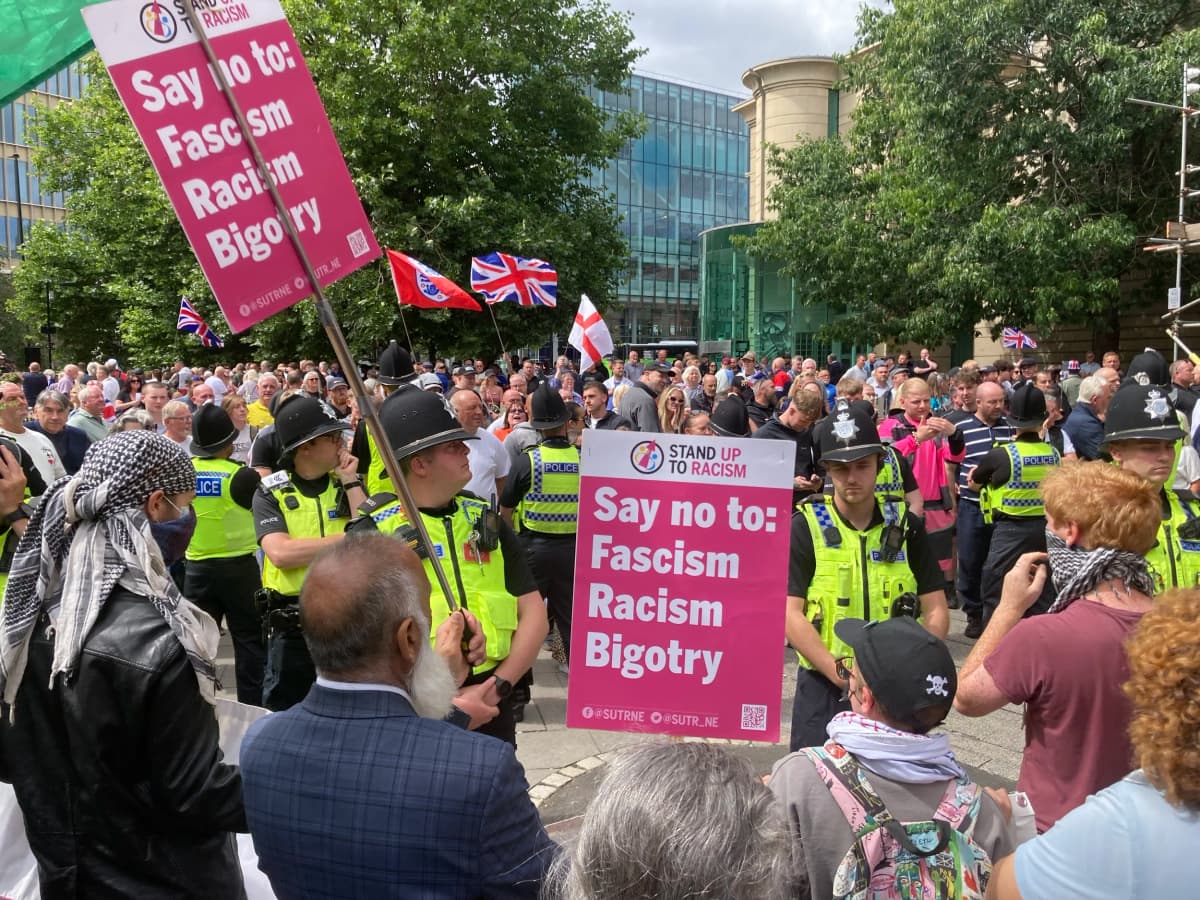
We also see extensive mobilisation of the extreme right on this issue, demonstrating the extent of their organisational capacity through the promotion of racist and xenophobic conspiracy theories online. These events have been referred to as ‘protests’ and as ‘mindless violence’, such as the attacks on a local mosque in Southport, an[Asian man assaulted in Hartlepool on 31 July](https://www.standard.co.uk/news/uk/asian-man-punched-racist-attack-hartlepool-riots-b1174202.html), or [a Black bus driver stabbed in London](https://metro.co.uk/2024/07/31/bus-driver-stabbed-death-on-way-home-shift-21336878/) on 30 July, and the widespread riots on 3 and 4 August at [Bolton, Manchester City](https://www.bbc.co.uk/news/articles/cervv8rz8mzo), [Rotherham](http://trib.al/4iOWKFv), These events are not ‘mindless’ and neither are they ‘protests’. They are public demonstrations of xenophobic and racist hatred, targeting Muslims, Asians and recent migrants. We know that family, friends, and communities across the country are sharing messages telling their sons and fathers to be careful when in public spaces, while women and girls are told to stay indoors or travel together for safety.
There has been a general failure to realise the extent to which questions of gender, and in particular the “protection” of the ‘white family”, is a central part of the way the racist far right seeks to exploit social anxieties and generate support for its xenophobic agenda. This has important historic[dimensions](https://journals.sagepub.com/doi/pdf/10.1177/16118944221110721) but was also, as we noted earlier, [a key aspect of far right conspiracies during the Covid pandemic](https://journals.warwick.ac.uk/index.php/feministdissent/article/view/1264). The calls for ‘protecting our women and girls’, alongside calling out ‘degenerate Muslim men who abuse their women’, only reinforces the patriarchal view of women as property – this is honour abuse by any other name. While making these calls for protecting women and girls against outsiders, the far right is not concerned, even slightly, about increasing levels of domestic violence against women and girls. One of the men seen rioting in Southport and attacking police on 30 July [was arrested in Southport for domestic abuse](https://www.merseyside.police.uk/news/merseyside/news/2024/july/fifth-arrest-following-disorder-in-southport/) [on the 31st.](https://www.merseyside.police.uk/news/merseyside/news/2024/july/fifth-arrest-following-disorder-in-southport/) Men fuelled by alcohol and drugs, who have committed acts of violence on the streets, will be returning to their homes – and we all know what’s likely to happen. Services must monitor this diligently through the calls received on their helplines.
As feminists we call out abuse in all communities. The posturing of men claiming to protect “us” from men from “other” communities needs to be understood as part of the strategy to racialise male violence. The religious leaderships that have established themselves as the spokespersons of minoritised groups are unable to name this strategy and oppose the racist and patriarchal ideas that it is based on. What we need is solidarity against all male violence. We need to oppose the tacit compliance of those who stand by silently as well as condemn the hypocritical [trope-ridden cheerleading of entitled press pundits](https://www.mattgoodwin.org/p/what-did-you-expect-britains-protests) who claim to speak for working people against ‘elites’.
It is important that these events not be labelled as ‘working class’ riots and violence. Local northern working class communities have come out in protest against this fascism, and some had already reported the attempted radicalisation of people via Facebook to the police (with little effect) in the days before the riots and public unrest in areas such [as Sunderland](https://www.bbc.co.uk/news/articles/cnl0lkrxgvxo). In the middle of this horror, we also see people pulling together. We see brickies giving their time to rebuild the wall of the mosque in Southport, neighbours clearing up the rubble in Southport and Sunderland, a lone woman standing against a crowd with a sign proclaiming ‘Hope not hate’ and ‘Racism not welcome here’. Residents of Liverpool have turned out en-masse to block attacks on a mosque in a show of strength that included the inspiring Nans Against Nazis. A number of anti-racist counter demonstrations are also planned across the North East in the coming weeks.
While many people have been shocked by the suddenness and extent of the far right’s violent mobilisation, it is important to understand that this has not come out of nowhere. As Sara Khan, former Commissioner for Countering Extremism recently noted, for the last five years in particular, [Conservative government ministers have been ‘giving the green light’ to the racist and xenophobic conspiracy theories of the extreme right](https://www.theguardian.com/uk-news/article/2024/aug/04/conservatives-left-uk-wide-open-to-far-right-violence-says-former-adviser). The former Conservative Home Secretary Suella Braverman repeated the language of the extreme right in describing asylum seekers who arrived on Britain’s shores after the most desperate and dangerous journeys as [‘invaders”](https://www.reuters.com/world/uk/uk-interior-minister-braverman-sent-official-documents-personal-email-six-times-2022-10-31/). Nigel Farage, now an elected MP for the ‘Reform’ Party, has been promoting misinformation about the extent of migration to the UK, and has been given extensive support to present these ideas in the pages of The Sun, The Daily Mail and The Telegraph. This latest mobilisation of the far right, which is once again based on lies and disinformation, represents their attempt to use the violence faced by women and girls to promote their agendas; we see this when we watch women and children among the far right rioters on TV and social media.
The extent of this mobilisation affects us all – Muslim, non-Muslim, white and non-white, religious and non-religious and it is not going to go away on its own. Ultimately, it will take all our solidarity and creativity to defeat these 21st century pogromists and to formulate more hopeful futures for people instead of pandering to a politics of hatred and blame. Many of the founders of Feminist Dissent were active participants in the anti-racist movements of the 1970s and 1980s which saw black communities and their allies on the left organising to defeat an earlier incarnation of fascist hatred and violence. We see it as more important than ever that we bring the history of building a secular, feminist, anti-racist and left perspective into the current struggles against fascism.

Book Launch: Sexed — A History of British Feminism
Book launch for "Sexed — A History of British Feminism" attended by Project Resist.

Resourcing Our Resilience: Black Feminist Mapping Across the FiLiA Legacy Cities
Blog by Rosie Lewis (Project Resist)
“We want a women's movement that is for all women, and we mean Black women who are from communities where they are already dealing with violence and abuse... we are campaigning on our own and we want support, or this isn't feminism.” (All quotes throughout are taken from Project Resist’s interviews with regional grassroots black and minoritised women’s groups.)
[The FiLiA Legacy Project](https://www.filia.org.uk/latest-news/2024/7/1/resourcing-our-resilience-black-feminist-mapping-across-the-filia-legacy-cities-by-rosie-lewis-and-pragna-patel-project-resist) (Campaigns and Policy) is a three-year project that continues a feminist tradition of independent grassroots campaigning and policy making. Project Resist, a Black and minoritised-led feminist organisation, is supporting FiLiA’s project by ‘mapping’ and documenting (via consultation) the work of Black and minoritised women-led organisations who are based in and around six FiLiA ‘legacy’ cities: Manchester, Bradford, Glasgow, Portsmouth, Cardiff and Brighton. The FiLiA Legacy Project is about policy making from the frontline, centring rights-based activism and the lived experiences of women and girls still excluded from mainstream political punditry and law making. As the UK approaches a general election in which women’s rights appear to be of little concern to any of the political parties, this project is both timely and critically important.
Building Regional Resistance
“It's as if BME women are second class citizens and have no rights. When I support women, I get threatened, I've lost contracts and jobs because I won't stop but there's a really big problem here. People don't know how violent these men are and what they do to control women in our community.”
Project Resist’s work highlights the often-discriminatory state and community context within which regional Black and minoritised organisations, groups and women exist. Regionally led women’s organisations and groups, particularly in the north of England, face higher levels of racism, isolation and ‘non-inclusion’, a disproportionately low level of investment in and funding for issues that are often excluded from mainstream London-centric policy making.
Project Resist has been mapping FiLiA’s legacy cities by focusing on less visible groups and using existing contacts and networks to reach smaller grassroots community-based groups, as well as more established organisations. First-hand testimonies and organisational data have produced robust case studies to evidence the deleterious impact of regional policy-making and national legislation and politics on Black, minoritised and migrant women located in very different parts of the country. As a result, it is startlingly obvious that when existing mainstream policies and legislation fail to centre the concerns of Black and minoritised women and girls, they can be both antagonistic and harmful.
Fighting for Our Sister’s Rights
Project Resist has so far engaged thirty Black and minoritised women across the six FiLiA legacy cities who are, on a daily basis, taking a brave and bold stance in their communities to advocate for women’s concerns and rights. Black and minoritised women face the double jeopardy of racism and misogyny that also manifests through patriarchal religious and ‘cultural’ control and fundamentalism as well as harmful practices such as honour-based abuse, immigration related abuse and forced marriage. These are practices that are enabled by local political networks that are often characterised by cronyism and corruption.
“The men in the Mosques and Gurdwaras who have power are the same men in the community who are telling the women not to report domestic abuse, not to bring shame on the community by not marrying men they don't want us to marry, the same men who tell girls they have to leave education... and the local authority and political leaders give them the license to do this.”
Organisations, groups and activists are often alone in their localities fighting for the rights of Black, minoritised and migrant women on all fronts, battling with the state, statutory services and with communities, as well as generic white-led women’s organisations and gender-neutral charities that fail to share resources. They are doing this whilst providing support (from crisis through to recovery) to the most vulnerable women and children fleeing violence in a context where there is a cost-of-living crisis, vehement media-led anti-migrant rhetoric and a shocking political and cultural shift towards nationalist populism. For example, single migrant women and those with children accommodated in Glasgow are experiencing a range of draconian state measures that police, restrict and diminish further their liberty and safety. As a result, local migrant led women’s groups have come together to advocate for the human rights of women who have been trafficked, sexually exploited, abused and tortured, while also providing them with financial subsistence and necessities such as blankets, culturally appropriate foods, and baby formula milk with little or no support or funding and resources.
“Women are terrified about the Rwandan policies, they are underground, and it means they are in more danger. We've not seen any of the big women's organisations up here say anything about this, and none of the women can access their services because they have no recourse to public funds. Who is listening to their voices? Who is fighting for them?”
In addition, Covid-19 has had a devastating impact on Black and minoritised women and children’s health and their civil liberties. Multi-agency restrictions that emerged during the pandemic stymied the implementation of the equality duties as many statutory agencies ditched them. This encouraged the further exclusion of Black and minoritised women’s organisations at a strategic and consultative level at a time when the cost-of living crisis was already immobilising their work. In short, Black women in some regions no longer had a seat at the strategic policy table.
“We are told all the time there is no funding for you, because you work with migrant women or there is no funding because you train women and don't just do domestic abuse. It's clear racism because we are an African-led organisation and we are treated with suspicion. We get asked endlessly about our accounts as if we can't be trusted with money. This kind of racism and discrimination isn't seen and no one will help us with it or fight with us outside of our community but it's how decisions about policy and funding are written in ways to keep us out.”
Following the pandemic, gender neutralisation and the corporatisation of the domestic abuse sector has accelerated, alongside the deliberate excision of migrant women’s rights under the 2021 Domestic Abuse Act. This has resulted in diminished funding for Black and minoritised women’s organisations, especially those who support migrant women’s rights. Black and minoritised women’s work is also increasingly being co-opted by generic women’s organisations who are seen to be ‘representing’ all women’s concerns at a policy or strategic level but are routinely failing to articulate Black and minoritised women’s concerns and rights.
Policy Making and Campaigning from the Frontline
Structurally and politically, Project Resist wants to ensure that that Black and minoritised-led frontline organisations and groups are strategically placed in political debates, in campaigns for women’s rights and in the national policy-making sphere. We will work in sisterhood and solidarity with FiLiA, with whom we share common values and a political vision for the liberation and empowerment of all women including marginalised women and girls.[[2]](https://www.filia.org.uk/latest-news/2024/7/1/resourcing-our-resilience-black-feminist-mapping-across-the-filia-legacy-cities-by-rosie-lewis-and-pragna-patel-project-resist#_ftn1) Connecting and engaging with organisations, particularly underfunded and un-constituted groups is a key part of grassroots Black feminist collectivist organising. In building solidarity and sisterhood, we are building the opportunity to share resources amongst groups and to build a movement outside the mainstream power structures that is resilient and sustainable. If we don’t come together and share resources and power equitably, feminist solidarity will be reduced to lip service, and will work in the interest of ‘some’ women and not all. Project Resist’s involvement in the FiLiA Legacy Project will, we hope, help to bridge the existing gap between regional networks of community activists, campaigners and policy makers. Above all it will help position the involvement of Black and minoritised women at the forefront and centre of FiLiA’s policy making and campaigning work.
About the FiLiA Legacy Project:
FiLiA has held large feminist conferences in cities in the UK ever since 2013. FiLiA stays in contact with women in the cities where conferences have taken place and is involved in projects to make women’s lives better in each one. FiLiA aims to build sisterhood and solidarity, amplify the voices of women and to defend women’s human rights and to do this locally, nationally and globally. We’re keen to hear about women’s concerns, what they think the big issues for women are and of the campaigns they’re already involved in to make things better for women. We are also just as interested in the campaigning that you think should be going on but isn’t.
Through the FiLiA Legacy Project ‒ Campaigns and Policy, (FLP ‒ CP), we want to make sure women’s voices are heard in ways that lead to policy changes where it matters to women. We want women themselves to know how to campaign and to support them when they do so. The project is just beginning, and we’ll make sure that we have ways of asking women what’s important to them throughout. It matters to us that we authentically represent women and that we help women achieve the changes that genuinely matter to them.
[[2]](https://www.filia.org.uk/latest-news/2024/7/1/resourcing-our-resilience-black-feminist-mapping-across-the-filia-legacy-cities-by-rosie-lewis-and-pragna-patel-project-resist#_ftnref1) By referring to ‘marginalised’ women we refer, as FiLiA does, to a: “those who are disadvantaged and multiply marginalised due to sex, race, class, disability, sexuality, age, poverty, sanctuary-seeking status, working-class women, otherwise minoritised women, those who have been in care and/or have experience of the criminal justice system or have experienced violence and abuse.”

Domestic Homicide Review Statutory Guidance Consultation: Project Resist Submission
Project Resist made a written submission to the Home Office consultation on updating the Domestic Homicide Review (DHR) statutory guidance.
The submission called for explicit attention to suicide following domestic abuse, and for DHRs to consistently capture intersectional factors affecting minoritised women.

The Michaela School Ruling: Religion, Education and 'British Values'
Blog by Feminist Dissent
NOTE: This article was written in late June 2024, before the July 4th national elections in the UK that were won by the Labour Party. It refers to ministers from the Conservative Party who are now no longer in office. However, the overall points we raise about the place of religion in schools are still very urgent and relevant.
On 16 April 2024 a female Muslim pupil lost her High Court challenge against the banning of Muslim prayers at Michaela Community School, a secular secondary ‘Free School’ in London. Those of us who have been monitoring and challenging the encroachment of religious fundamentalism in schools and colleges breathed a collective sigh of relief at this Court Ruling. This significance of this case impacts on the rights of all pupils; and in particular, the principle of freedom from religion; and this is a central issue for Muslim girls particularly in terms of safety, choice and self-determination. This ruling takes place in a context where for many years, religious fundamentalists have been seeking to exercise disproportionate influence in the running of schools, and indeed to taking control of many schools in a manner that is very often facilitated by government policy, as we detail below.
Michaela School is located in the highly multicultural London borough of Brent and has around 700 pupils from diverse ethnic and religious backgrounds, with around half from Muslim backgrounds. The School Head, Katherine Birbalsingh, is a controversial figure who was at the centre of an ITV Documentary which dubbed her ‘Britain’s Strictest Headmistress’ (ITV 22/5/20222). Birbalsingh is [closely allied with the Conservative Party](https://bylinetimes.com/2023/07/11/braverman-and-birbalsingh-the-close-tory-ties-of-the-right-wings-beloved-strictest-headmistress/) and is a champion of the policy of ‘Free Schools’ policy (which are schools funded directly by central government, outside the auspices of Local Education Authorities). In the field of education, Birbalsingh has taken a [highly disciplinarian approach](https://joe-kirby.com/2016/12/10/no-excuses-high-standards-high-support/) to the running of her school which has involved a rigorous implementation of “tough love – [authorative” approach to education](https://www.theguardian.com/education/2016/dec/30/no-excuses-inside-britains-strictest-school#:~:text=At%20the%20Michaela%20community%20school,teacher%E2%80%9D%20by%20the%20Sunday%20Times.) . Alongside this is her mission to minimise the social distance between the pupils in order to encourage them to see themselves as a “team” whilst at school. It was in this context that the Head and the school governing body refused the demands made by a Muslim pupil (the claimant in a High Court case) to be allowed to perform Muslim prayer rituals during the lunch break on the school premises. The ban applied to any prayer rituals regardless of religion.
Legal Arguments
The ban on prayers formed the basis of the legal challenge brought by the claimant pupil who had also been excluded from the school for short periods for contravening the school policy on prayers. The case turned on the questions of whether or not her demand for the right to perform prayers breached her human right to manifest her religious beliefs (Article 9 of the European Convention on Human Rights) and whether it amounted to indirect discrimination and a violation of the public sector equality duty which requires public bodies to eliminate discrimination, advance equality of opportunity and foster good relations as set out in the Equality Act 2010.
The school argued that its decision did not amount to an interference with the pupil’s rights since, there were no rigid Islamic rules on the timing of Muslim prayer rituals and in any event, the pupil had chosen to attend a secular school even though she was aware of its strict regime of governance. It also stated that the pupil had been free to attend other suitable schools in the area.
On 16 April 2024, the High Court delivered an 83-page judgment dismissing the pupil’s case. The court accepted the school’s arguments ruling that the pupil claimant’s right to manifest her religion was not breached. On the discrimination point, the court also maintained that the school was justified in its decision because it had to balance the needs of the pupil against the need to achieve the legitimate aims of the school to encourage integration and foster a sense of ‘community’ in the school. It also ruled that any indirect discriminatory effect was justified since the demands of the pupil conflicted with the school’s ethos and rules and was impractical to implement.
Responses to the ruling
The outcome of the High Court case has received the typical ‘culture wars’ framing, which constructs the issues through an opposition between ‘British’ and ‘Muslim’ identities, with the political Right championing ‘British’ values, and with progressive opinion seeing the key question as anti-Muslim racism. For the political Right, the court ruling makes Birbalsingh a champion of “British” values and defender of Britain’s “Christian identity”. (The affair has even been used as an opportunity to make a sideways sweep at protesters demanding a ceasefire in [Gaza.](https://www.thesun.co.uk/news/25439577/school-religious-spat-future-britain/)) Both the hard-right former British Home Secretary Suella Braverman (who was herself a former Governor at Michaela School) and the current Equalities minister Kemi Badenoch were both fulsome in their praise of the ruling.
Muslim and Race Equality groups by contrast have denounced the ruling as [discriminatory against Muslims.](https://www.mend.org.uk/michaela-school-discrimination-against-muslims/) The Muslim Engagement and Development NGO (MEND) have stated that the ruling has made it “harder for Muslim students to authentically express their Islamic identities” and “sets a dangerous precedent and could risk encouraging a wave of bans on religious expressionism in schools, and perhaps even beyond into other areas of the public sector.” The journalist Nadeine Asbali has characterised the ruling as “Islamophobic” and as symbolic of a [“dystopian, sinister vision view of Britishness”,](https://www.theguardian.com/commentisfree/2024/jan/19/ban-muslims-praying-school-britain-multiculturalism) which she sees as a broader reflection of that way we are “living in an atmosphere that seeks to criminalise Muslimness at every level”. The Runneymede Trust has echoed this position and gone as far as to say that the ruling sets a ”dangerous precedent”. Without bothering to acknowledge the specific facts of the case, it draws connections between the court ruling and the State’s policies on [Prevent](https://feministdissent.org/full-issues/issue-4-2019-special-issue-prevent/) and counter-extremism to underline its point that Muslim identity is being “policed” unfairly.
Behind the Culture Wars Headlines
These apparently polarised responses obscure the key issues at play within the wider context of UK Education policy. The fundamental direction of Conservative education policy at the moment is to deny the existence of structural inequalities in the British education system. Birbalsingh’s educational emphasis on “hard work and personal responsibility” is lauded by the Right precisely for the way it displaces the impact of gender, ‘race’ and class on educational outcomes – indeed in her statement after the court ruling Birbalsingh dismissed the latter as “identity-politics victimhood”. [The policy of ‘Free Schools’](https://journals.sagepub.com/doi/10.1177/14782103231176360) was developed by the Conservative Party precisely to elevate this approach, though even the Department of Education’s own figures illustrate the despite the huge investment in the programme most of these have largely [failed to make any impact](https://www.theguardian.com/education/2021/feb/09/michael-gove-free-schools-at-10-successful-policy-since-the-war-or-mistake) in student attainment overall.
At the same time, we would argue that this ruling is important for the way it has supported the school in standing up to the divisive and intimidatory impact of identity politics based on religion. The school’s implementation of policies such as serving vegetarian food only so that pupils can “break bread with each other across racial and religious divides” is a valuable attempt to manage diversity and prevent segregation. However rather than framing this as a policy of ‘British values’, what we see as most valuable here is the relationship between secularism and inclusion. It is a poor reflection on the Left that they have so uncritically endorsed religious identity politics that they have to take lessons from an educational reactionary such as Birbalsingh on questions of how to negotiate difference. The idea of seeing a school as a place where staff and students see themselves as part of a shared community of learning has historically been a progressive ideal; and we see secularism as the basis of creating such an inclusive environment.
We particularly welcome the [high court’s](https://www.judiciary.uk/wp-content/uploads/2024/04/Judgement-R-v-Michaela-Community-Schools-Trust.pdf) alertness to the harmful impact of allowing prayers on those Muslim pupils who chose not to be observant. The court noted that the claimant pupil and her friends made demands for the right to pray following a conversation with a visiting headteacher of an Islamic school who encouraged them to ask questions about the behavioural rules of the school including the right to pray in the school yard. Acting on his words, 30 pupils not only defied the school rules on praying but also set about policing and harassing other Muslim pupils who chose not to pray or not to fast or who joined the school choir or rejected the hijab. The consequence was a head on clash with the head and staff who were subject to an online campaign of harassment and abuse that included an online petition against them signed by 4000 people. Prejudicial comments about the school favouring gays and Jews and references to the Klu Klux Klan, slavery and lynching were also posted in support of the petition along with videos on YouTube and Tik Tok accusing the school of Islamophobia. A brick was thrown through the letterbox of the home of a member of staff and a hoax email was also sent to the school stating that a bomb had been planted outside the school. The level of intimidation and threats faced by non-observant Muslim pupils and the staff led to considerable disruption. The school was forced to report matters to the police, engage the services of security guards and to close early for the Easter holidays. Eventually, it also led the school to the ban prayers and to take disciplinary action against the claimant pupil that included exclusion from the school for short periods.
The fundamentalist mindset
What the event above reflects is, as we have argued for some time, the way in which religious fundamentalists across the board see the control of education as a key political battleground.
To this end, fundamentalists have mobilised pupils and parents to make demands for state funding for faith-based schools as well as sex segregated educational spaces, separate dress codes for girls and the right to withdraw children from sex education and other parts of the state school curriculum that do not conform with their religious dogma. It is also the case that government policies, rather than challenging this, have facilitated it. The ‘Trojan Horse Schools affair’ in Birmingham in 2014, was similarly represented as a conflict between ‘liberal British’ and ‘Islamic’ values. What was ignored in this portrayal of the issues was how the space in which religious fundamentalists were so able to promote their agenda in the schools “[was provided by government policy itself](https://journals.sagepub.com/doi/full/10.1177/0261018316670252)”. The dispute about [Relationships and Sex Education in Birmingham](https://feministdissent.org/reports-and-papers/) in 2019 was further evidence of the way fundamentalist groups have sought to mobilise parents and target schools and in pursuit of their wider political agenda, to de-secularise and control the school curriculum. There are two key strands to this strategy by fundamentalist forces. The first is through asserting an absolute right to manifest religion in state schools. What occurred in Michaela echoes the issues raised in the high -profile case of [Shabina Begum and Denbigh School](https://publications.parliament.uk/pa/ld200506/ldjudgmt/jd060322/begum.pdf) in 2006, which involved an attempt by Shabina, a young Muslim pupil, to assert her right to wear the jilbab (long sleeved and floor length tunic dress) against the school uniform policy. She argued unsuccessfully that wearing the jilbab was integral to her Muslim beliefs and that the school had discriminated against her by rejecting her demand. However, her argument masked a profoundly sex discriminatory agenda driven by fundamentalist forces. The second strand to this strategy is through setting up faith-based schools in order to opt out of state control and scrutiny. There is a deep irony to the way Conservatives have presented Micheala School as a champion of ‘British Values’ when the Free Schools programme has itself become one of the many vehicles religious fundamentalists have [used to establish their control over education.](https://www.bbc.co.uk/news/uk-england-derbyshire-24548690)
Conclusion
Religious groups and their supporters have seen the key issue at stake here as one of freedom of religion. While this right is important, it is also essential to situate this alongside the principle of freedom from religion, particularly in a context where religious coercion is prevalent, and not least because of the impact this has on girls and young women, who are more vulnerable to social censure and violent repercussions arising from non-compliance with religious norms. In the 2006 case mentioned above, Shabina Begum made her argument using the language of ‘Muslim female agency’ and ‘choice’; yet had she been successful, the jilbab could then have been institutionalised as a ‘Muslim’ dress code and imposed on the majority of other Muslim girls at the school, regardless of whether or not they wanted it. Cases like these, show how the language of ‘female agency’, ‘choice’ and even ‘human rights’ can be co-opted by fundamentalists to extend control over women and girls. They are targeted precisely because they are deemed to be central to the preservation of patriarchal ‘family values’ and traditional gender roles. Too much knowledge and sexual and intellectual freedom is considered by all religious fundamentalists to be incompatible to marriage and the role of women in the family.
The Micheala School ruling from the High Court was welcome. Yet in the same week that the right wing press and Conservative MPs were showering praise on Birbalsingh for standing up for ‘British Values’ against Muslim identity politics, the Government introduced a change to school admissions policies which meant that [faith schools in England would no longer be required to offer half of their places to children of different or no faith .](https://www.theguardian.com/education/2024/may/01/england-scraps-50-rule-on-faith-school-admissions) In this case the rationale was not about religion and faith, but about “raising standards”. These absurd contradictions sit within over a decade of Conservative policy experiments which have removed many religious schools from the necessary processes of accountability, in a context where even conservative thinktanks such as the Institute for Fiscal Studies have shown that [educational inequalities](https://ifs.org.uk/articles/uk-education-system-preserves-inequality-new-report) are as deeply entrenched as
they have ever been. In such a situation there is an urgent need for progressives to reclaim an agenda of integration and cohesion, and this is all the more important in the context of the increasing popularity of a right-wing nationalist politics blaming migrants for economic problems and asserting the incompatibility of Muslims within a ‘European’ polity. In such a context it is crucial for us to understand the multiple dimensions of inequality within education, and to focus on the material dimension of this instead of uncritically supporting the preoccupation with cultural and religious identities. We in Feminist Dissent believe that for a left, feminist and anti-racist political project to be rebuilt in the present context requires us to recover a language of universality (Assiter, 2016), of democratic rights and of the politics of secularism. Secularist approaches are not, as fundamentalists assert, a denial of the right to manifest religious belief. Rather they create the conditions where political debates are not trapped within an impoverished opposition between exclusivist forms of nationalism on one hand and the dogmatic imposition of faith, on the other. Our children, at the very least, deserve so much more than this.

Contesting the Hostile Environment
Event on contesting the UK Hostile Environment immigration policies.

Westminster Insights
Project Resist representation at Westminster Insights policy event.

Rosa Fund Conference
Rosa Fund's Summer Conference 2024 bringing women's sector organisations together.
.jpg&w=1200&q=75&dpl=dpl_24zXUduh2uAsPZ4wMYniiSbcEcyA)
Family Courts Speaking Event
Project Resist members took part in a closed-door speaking event on the family courts.
The discussion examined the systemic failures faced by minoritised women in private law proceedings, including the use of unregulated experts and the dismissal of coercive control allegations.

WRC Annual Conference 2024
WRC Annual Conference 2024: Currency of change — vibrancy and inspiration.

Defending the Rights of Women — Guardian Op-Ed
Pragna Patel of Project Resist wrote in The Guardian on the establishment of the UK's first Sikh court in London.
The op-ed warned of the implications of parallel religious legal forums for the rights of women in matters of marriage, divorce and child custody, and called for safeguards rooted in equality law.

Statement on the Genocide in Gaza
Blog by Feminist Dissent
Note: Since we’ve written this statement, a new expanded cycle of violence has opened in the Middle East, triggered by the Israeli attack on the Iranian consulate in Syria and the massive Iranian drone and missiles attack on Israel which was helped to be shot down with the help of UK and US forces. Where will it end?
Sunday April 7, 2024 marked exactly six months since Israel unleashed its brutal war on the Palestinian people in Gaza, a war that shows no sign of stopping any time soon.
We at Feminist Dissent can barely find the words to describe the pain and the rage we feel at the cruelty and injustice that has unfolded since 7 October 2023. On that day, Hamas and its associates assaulted, tortured and murdered many Israeli civilians and foreign nationals, including women and children – [1200 people were killed and 253 taken hostage, of which only 112 have been released or rescued and 12 bodies recovered](https://www.bbc.co.uk/news/world-middle-east-68745681). Those assaulted and killed included peace activists, some of whom were themselves Holocaust survivors, who had long committed themselves to a life in the service of humanitarianism, compassion and reconciliation between the two peoples. Hamas did not distinguish between the civilian population and the Israeli state.
Nor did Israel when it began its campaign of revenge – ostensibly against Hamas – which has turned out to be a brutal all-out war on the people of Gaza who continue to be demonised, dehumanised, dislocated and killed en masse. In the last six months, 33,494 Palestinians have died, including more than 13,000 children and 8400 women. [A further 8000 people are missing.](https://www.aljazeera.com/news/longform/2023/10/9/israel-hamas-war-in-maps-and-charts-live-tracker) These figures don’t include those who are injured or those dead in the West Bank.
It is self-evident that this is not a symmetrical war or a war without context. While both Hamas and the Israeli state represent fundamentalist and anti-democratic forces of terror and repression that feed off each other, they do so in a profoundly unequal dynamic in which Israel is the dominant force, given the sheer might of its military power and western backing. Gaza has been kept as a virtually open-air prison for years and Israel has long held the belief that its divide and rule policy of the various Palestinian factions will enable it to continue its domination of the Palestinians undisturbed. It has aspired to reach ‘normalisation’ with other Middle Eastern countries while ignoring the Palestinian issue. The Hamas attack exposes the limitations of such policies, especially in a neoliberalised and religionised Israel that has abandoned most of its citizens in favour of specific economic and especially religio-nationalist interests.
[The relationship between Israelis and Palestinians has to be understood through a history of ongoing settler colonialism, occupation and racialised apartheid fed by the Zionist settler project and increasingly, by Jewish right-wing and fundamentalist politics](https://journals.warwick.ac.uk/index.php/feministdissent/article/view/760). The tragedy of this war is that the attack by Hamas has enhanced Israeli existential anxiety and added the thirst for revenge to the increased dehumanisation of ‘the other’, which has been growing in Israeli occupation policies. As a result, the war’s aim to ‘finish Hamas’ – an organisation that Israel has cultivated for years as an intra-Palestinian political power countering the secular and then more progressive PLO – has in practice become a war aimed at the total annihilation of Palestine. By blocking humanitarian aid and by destroying the Palestinian legal, social, cultural, religious and economic infrastructure needed to sustain life, Israel has moved from domicide to ongoing genocidal policies that include [starvation as a weapon against the people of Gaza](https://www.nybooks.com/online/2024/03/30/the-road-to-famine-in-gaza/). Israel’s AI-driven military campaign has enabled it to extend the war in all directions to encompass all parts of Palestinian society including journalists, educators, health and aid workers, the elderly and the sick. The widespread death, displacement and devastation that has followed has led the UN and many humanitarian agencies to warn of the ‘imminent danger of famine’, which in fact is already a reality to more and more of Gaza’s inhabitants especially in the north.
The warning signs of an impending genocide were there from the beginning. Following international outcry, in January 2024 South Africa successfully pushed the International Court of Justice to provisionally rule that Israel is engaged in plausible acts of genocide and to call for an immediate ceasefire in compliance with Israel’s obligations under the Genocide Convention. Israel’s shameless rejection of the ruling signifies a staggering sense of impunity enabled by the backing of the UK and other western powers. The encouragement, military and financial support of Israel by the US, Germany, UK and others, epitomises a new low in our post-war rules-based international world order. It represents a naked show of opportunist complicity and the degradation of global leadership that has descended into dangerous levels of legal, moral and political bankruptcy. It is precisely this collusion that led former Supreme Court judges and lawyers in the UK to take the unprecedented step of issuing a letter warning that the [UK is itself at risk of seriously breaching international humanitarian law through policies such as its arms trade with Israel.](https://www.nybooks.com/online/2024/03/30/the-road-to-famine-in-gaza/)
An added dimension of the war is the sexual violence and rape Hamas committed against Israeli women. In regard to 7 October 2023, there is credible evidence pointing to a calculated assault on Israeli women whose bodies were violated, mutilated and used as weapons of war. We denounce these acts of brutality and depravity in the strongest terms possible and support independent investigations into these events as war crimes and crimes against humanity. Although the sexual violence did not reach the scale that we have previously seen in wars in Bosnia or Rwanda, clearly Hamas intended to exact revenge through the humiliation and degradation of Israeli women.
But Hamas’ acts of rape and mutilation come from the same ideological wellspring that plays itself out over the bodies of Palestinian women. In line with all religious fundamentalist movements, Hamas has rolled back women’s rights in Gaza by imposing discriminatory Sharia norms and laws that conceptualise women as inferior and justify restrictions on their movements, their oppression and other forms of violence against women. [For instance, year on year the numbers of Palestinian women who are assaulted or killed, including those in so-called honour killings, by violent men have increased in Gaza and in other Palestinian territories.](https://www.aljazeera.com/opinions/2019/9/4/israa-gharibs-murder-has-nothing-to-do-with-honour)
This is one just one of many reasons why Hamas does not symbolise some heroic fight for Palestinian liberation as some on the Left have claimed. It is a militant Islamist group that was created from the fundamentalist Muslim Brotherhood by the Israeli state in Gaza to sow division and weaken the Palestinian struggle for freedom. It is no more concerned with women’s human rights than the Israeli state, which has also wasted no time in instrumentalising the rape and sexual violence of Israeli women to justify the massacre of Palestinians. We should not forget that Israel too has its own long and sordid history of using sexualised violence against Palestinian women and even men and boys as a weapon of torture. At the same time, it also appeases Jewish fundamentalist and ultra-orthodox forces that demand greater patriarchal control of women within Israeli society.
The use of rape and violence against women in any context must be condemned but so must Israel’s subjugation of the people of Palestine, which not only depends on indiscriminate violence and surveillance but on genocide itself.
It is hard to have hope in these bleakest of times. But we would do well to remember that within Israel, resistance to Netanyahu’s disregard for the lives of the hostages and their families and to his brand of war mongering politics is growing, albeit for different political reasons. While Israel’s existence as an ethno-nationalist and apartheid state is not yet in serious jeopardy, its dubious claim to democracy and peace-seeking is unravelling fast.
While most politicians continue to excuse or defend Israel’s actions, outside of Israel resistance from all quarters of civil society is gathering momentum. Guided by notions of freedom, the rule of law and social justice, more and more people everywhere call not only for an end to the war or even to the post-1967 occupation; they call for a transformation of Palestine/Israel into a state where all residents of all ethnic, national, gender and class backgrounds can enjoy equal individual and collective human and civil rights. For those of us who see ourselves as secular, anti-racist, anti-fundamentalist and socialist feminists, the fight for the survival of our humanity and the core values that should underpin it has become an urgent political struggle.
Acknowledgements
"Art is a powerful act of resistance; it transforms struggle into beauty, ignites conversations, and inspires change. Through creativity, we challenge injustice and illuminate the path towards a more inclusive future."
— Shahina Jaffer
Shahina Jaffer
Project Resist is indebted to Shahina Jaffer for the reproduced artwork featured on this website. Shahina Jaffer, an acclaimed artist and graduate of Central Saint Martins, London, has showcased her work in galleries and cities across the globe, from New York to Mexico City and Florence. Shahina describes herself as a visual artist, TEDx speaker, and a theory tester. Her artistic journey is marked by a steadfast commitment to inclusion and justice, celebrating the rich tapestry of cultures, perspectives and experiences that define our global society. Her creations stand as a testament to the power of art in transcending boundaries and uniting individuals from all walks of life.
Ina Norrman
We would like to thank Ina Norrman for her brilliant original design that inspired our logo. Ina Norrman is a Swedish visual artist and designer maker, creating contemporary narrative jewellery in her London studio as well as larger creative community ‘making’ projects with a wide range of different institutions in London. These workshops explore how processes of creating with your hands can serve as a powerful catalyst for wellbeing and connecting individuals with the past and present, particularly within the realm of social issues. Website: https://www.inanorrman.com
Visit Website →Laura Crow
We would also like to thank Laura Crow for her design expertise and support in developing the Project Resist logo.
Our Supporters
Project Resist would like to thank our funders, the Resist Network, and our Advisory Board.