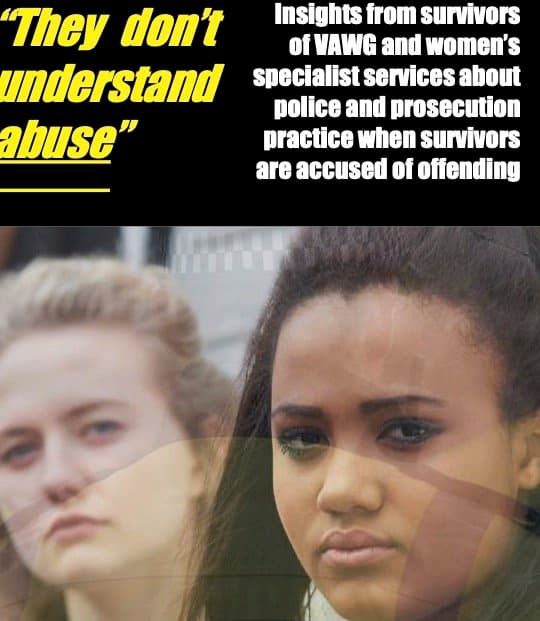
Pragna Patel, our co-director, conducted the research for the vital report published today by Centre for Women's Justice on the unjust criminalisation of women who are themselves survivors of abuse.
The report, 'They Don't Understand Abuse', shows that women who are victims of domestic abuse are being arrested, cautioned and prosecuted in circumstances that stem directly from that abuse, often after their abuser makes a counter-allegation.
It draws on a survey of 18 women’s specialist services, a round-table of 15 front-line providers, and interviews with five survivors. Every participant said that women’s experiences of abuse are not properly taken into account when police decide to arrest or prosecute them.
One shocking case covered in the report tells the story of woman who did not speak English who was subject to abuse by her partner, who was a social worker. He made allegations of child abuse against her. The frontline service supporting her commented: 'The police assumed he was telling the truth… Her children were left with her husband when she was arrested and he wouldn’t return the children to her. She had to leave behind a baby that she was still breast feeding. We had to really work hard, firstly to get the charges of child abuse dropped and we had to challenge social services to get her children back.'
The report identifies a culture of disbelief, poor understanding of coercive control, public interest tests that aren’t properly applied, a lack of trauma-informed practice, and particular discrimination against Black, minoritised and migrant women. The consequences include separation from children, loss of refuge access, damaged immigration cases and barriers to compensation.
It concludes that for some women, the state has become a site of harm rather than a site of protection.
Among its recommendations, the report calls for a joint police and CPS protocol for handling cases where the suspect in a case may also be a victim of domestic abuse, and improved training and guidance for police and prosecutors, with a specific focus on Black, Asian, minoritised and migrant victim-survivors.
Read the full report here