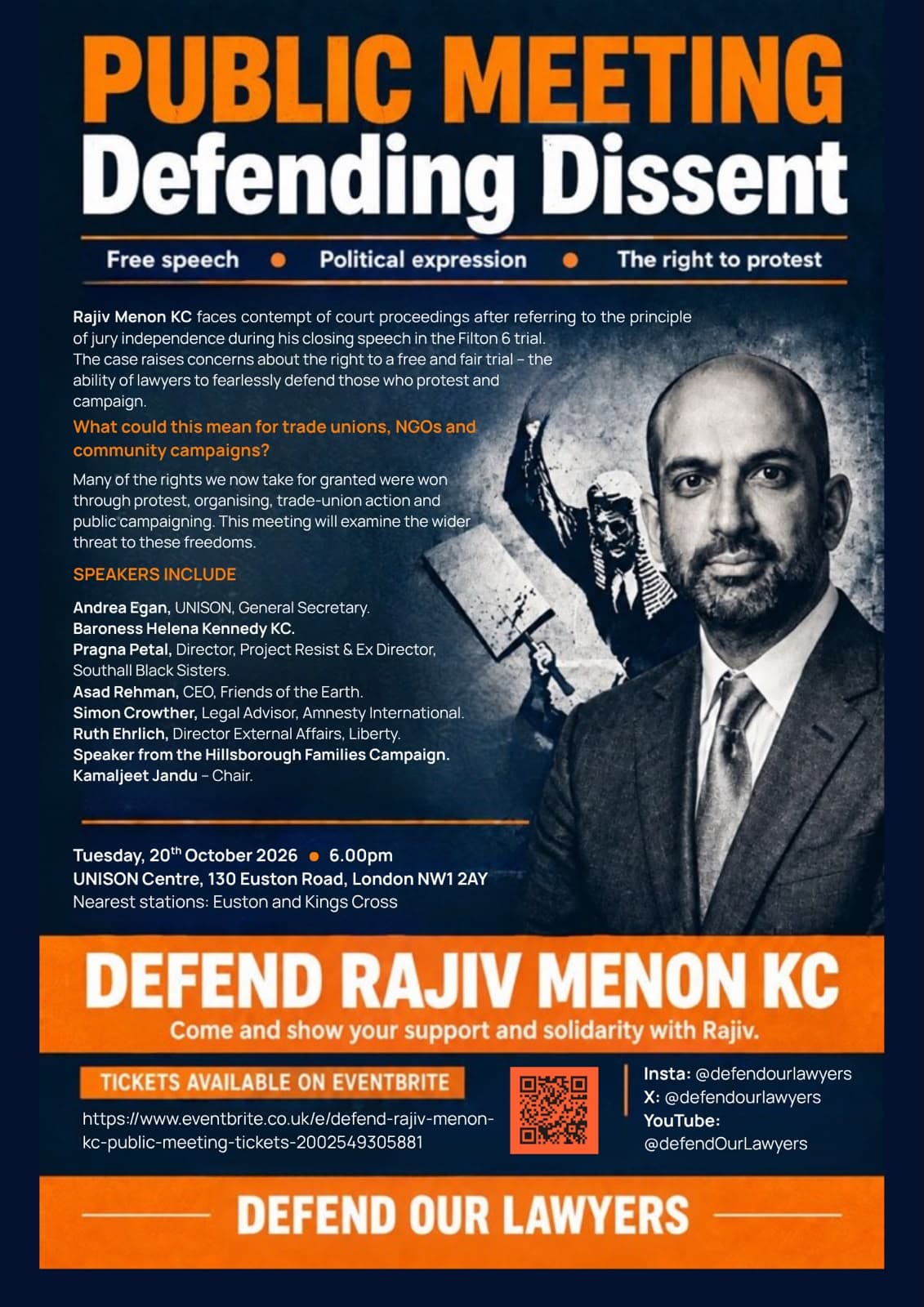
Rajiv Menon KC faces contempt of court proceedings after referring to the principle of jury independence during his closing speech in the Filton 6 trial. The case raises concerns about the right to a free and fair trial, and the ability of lawyers to fearlessly defend those who protest and campaign.
What could this mean for trade unions, community campaigns - and women's rights?
Come along to this urgent public meeting on 20 October to find out more and build solidarity in defence of Rajiv Menon and the right to protest and a fair trial.
Rajiv Menon KC is a highly respected human-rights barrister with more than 30 years’ experience in criminal law, inquests, and public inquiries. His notable work includes representing ten Hillsborough families at the Hillsborough Inquests; Duwayne Brooks at the Stephen Lawrence Inquiry and participants in the Grenfell Tower and UK Covid-19 Inquiries.
Menon delivered his closing speech on behalf of his client Charlotte Head in the first trial of 6 people accused of criminal damage and grievous bodily harm relating to the Elbit System Factory in Filton near Bristol. In this speech he said ‘…I am absolutely not asking you to disregard His Lordship’s legal directions. On the contrary, I’m asking you to follow them, in particular, in particular this section on the functions of judge and jury,…’
After the speech, the prosecution alleged Rajiv Menon was in contempt of court. The following day, the judge allowed the trial to continue and did not discharge the jury. Three days later, without prior notice to Rajiv Menon or inviting his response, the judge issued a reserved judgment criticising parts of the speech. Normally, concerns about a closing speech are dealt with by correcting the point during the trial. In more serious cases, referral to the Bar Standards Board is available, although even that is uncommon.
The use of contempt proceedings in these circumstances is unprecedented.
The process appears unfair and contrary to natural justice, raising concerns about unjust outcomes, authoritarian practices, and the judiciary’s role in enabling them. More broadly, the case reflects growing concern that legal powers are being used to restrict legitimate protest, political expression, and dissent.
The wider risks are clear. Defence lawyers may be punished for representing clients robustly. Jury independence, a cornerstone of democratic justice, may be undermined. Freedom of expression, assembly, and association may be weakened.
If a senior barrister can face contempt proceedings for referring to jury independence, it sends a chilling message to the legal profession: advocate too robustly, and you may be next.
The implications of this case extend far beyond the legal profession. It represents a broader attack on the right to protest, to organise, and to challenge injustice—whether in the workplace or on a picket line. The issues raised go to the heart of democratic participation and collective action.
Come and show your support and solidarity with Rajiv Menon - and hear from Project Resist's co-director Pragna Patel, alongside campaigners including Asad Rehman from Friends of the Earth, Helena Kennedy KC, Angela Egan from Unison, and Simon Crowther from Amnesty International.
Book your tickets here
Read our statement in defence of Rajiv Menon here and email comms@projectresist.org.uk to add your name in support.